CATEGORY - PAYMENTS
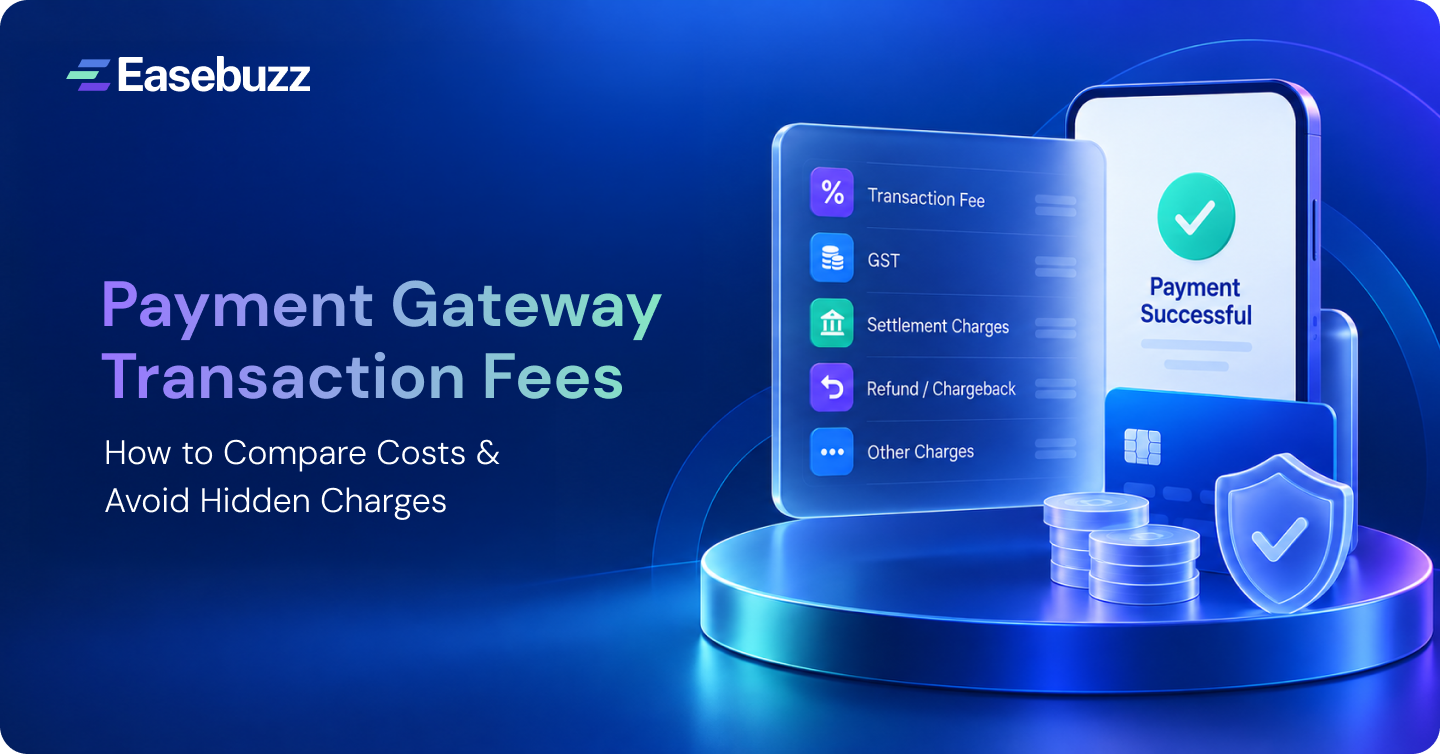
Payment Gateway Transaction Fees: How to Compare Costs & Avoid Hidden Charges
Payments - 10 Sept, 2026
-
Table of Contents
When a customer makes an online payment, the transaction cost is not always limited to the headline MDR or transaction fee quoted by a payment gateway.
Depending on the payment method and commercial agreement, businesses may also need to consider applicable GST, settlement charges, refund or chargeback costs, setup or recurring fees, and other service-specific charges.
That is why comparing payment gateways only on the basis of the lowest transaction fee can give an incomplete picture.
A better approach is to understand the complete cost of accepting digital payments and compare providers based on pricing, payment methods, settlement terms, payment success rate, reporting, and the services included in the agreement.
Key Takeaways
-

MDR is only one component of the overall cost of accepting online payments.
-
Businesses should check applicable GST, settlement, refund, chargeback, setup, recurring and other service-related charges.
-
Payment gateway pricing can differ depending on the payment method, merchant category, transaction volume and commercial arrangement.
-
UPI and RuPay debit card pricing is undergoing changes in 2026, making it important to verify the latest applicable terms before signing or renewing an agreement.
-
A lower MDR does not necessarily mean a lower overall payment cost. Payment success rate and operational efficiency also matter.
-
Transparent pricing means the applicable charges, taxes, settlement terms and other commercial conditions are clearly communicated before onboarding.
What Are Payment Gateway Transaction Fees?
Payment gateway transaction fees are the charges a business pays for processing digital payments through a payment gateway.
The amount can vary based on factors such as:
-
Payment method used by the customer
-
Merchant category or business type
-
Transaction volume
-
Domestic or international transaction
-
EMI or other financing option
-
Commercial agreement with the payment provider
One of the most commonly discussed components is MDR, or Merchant Discount Rate.
However, MDR should not be treated as the complete cost of payment acceptance. Businesses should evaluate all applicable charges and terms together before selecting a payment gateway.
What Does Transparent Payment Gateway Pricing Mean?
Transparent payment gateway pricing means that businesses can clearly understand what they will pay, when they will pay it, and what services are included.
A transparent pricing structure should make it easy to identify:
-
Transaction or MDR charges by payment method
-
Applicable taxes, including GST
-
Settlement timelines and any associated charges
-
Refund and chargeback terms
-
Setup or onboarding charges, if applicable
-
Recurring or annual charges, if applicable
-
Instant settlement or accelerated payout charges, if applicable
-
International payment and currency conversion charges, where relevant
-
Any minimum transaction or volume commitments
-
Commercial conditions that could change the applicable pricing
A charge is not necessarily a "hidden charge" simply because it is separate from the headline MDR. The important question is whether the charge and its conditions were clearly disclosed to the merchant.
What Does MDR Mean in Payment Gateway Pricing?
MDR stands for Merchant Discount Rate.
It is the fee charged for processing a payment transaction and is generally expressed as a percentage of the transaction value.
For example, if a merchant processes a ₹10,000 transaction at an illustrative MDR of 2%, the MDR would be ₹200.
Applicable taxes and other charges may be calculated separately depending on the pricing arrangement.
The actual MDR offered to a business can vary based on factors such as payment method, merchant category, transaction volume and the agreement with the payment provider.
Therefore, businesses should compare payment-method-wise pricing rather than relying only on one advertised MDR.
What Charges Should Businesses Check Beyond MDR?
Before choosing a payment gateway, businesses should review the complete commercial structure.
-
Transaction or MDR Charges: This is the percentage charged on eligible payment transactions. Rates may vary across UPI, cards, net banking, wallets, EMI and international payments.
-
GST on Payment Gateway Fees: Applicable payment gateway fees can attract GST. Businesses should check whether the quoted pricing is exclusive or inclusive of GST and understand how it will appear on invoices.
-
Settlement Charges: Some providers or plans may charge for specific settlement arrangements or accelerated settlement services.
Check the standard settlement timeline as well as any charges for requesting faster settlements.
-
Refund Charges: Understand whether a refund attracts a separate fee and how the original transaction fee is treated when a transaction is refunded.
The terms can vary by provider and agreement.
-
Chargeback and Dispute Costs: Chargebacks can involve operational and financial costs. Merchants should understand the applicable chargeback process, dispute handling requirements and any associated fees.
-
Setup or Onboarding Fees: Some payment providers or specific commercial arrangements may include one-time setup, onboarding or implementation charges.
Always confirm whether these apply to your plan.
-
Recurring or Annual Charges: Check for annual maintenance charges, platform fees, minimum commitments or other recurring costs, where applicable.
-
Custom Integration or Additional Services: Standard API access may be included, while specialised integration, custom development or additional services may have separate commercial terms.
-
International Payment Charges: Businesses accepting international cards or payments in foreign currencies should also check applicable cross-border, currency conversion and settlement charges.
Payment Gateway Charges by Payment Method
The cost of processing a payment can vary significantly depending on the payment method.
| Payment Method | What Businesses Should Check |
|---|---|
|
UPI |
Applicable MDR and current regulatory/payment-network terms |
|
Debit Cards |
Card network, card type, merchant category and applicable MDR |
|
Credit Cards |
Card network, card type, merchant category and applicable MDR |
|
Credit Cards |
Card network, card type, merchant category and applicable MDR |
|
RuPay Credit Card on UPI |
Applicable MDR, transaction value and merchant category |
|
Net Banking |
Transaction or processing fee applicable under the merchant agreement |
|
Wallets |
Applicable wallet-specific transaction charges |
|
EMI / BNPL |
MDR, financing-related commercial terms and applicable fees |
|
International Cards |
Cross-border pricing, currency conversion and settlement terms |
There is no single transaction fee that applies uniformly to every business or every payment method. Businesses should ask providers for a payment-method-wise rate card or commercial proposal before making a decision.
What Has Changed for UPI and RuPay MDR in 2026?
UPI and RuPay MDR pricing changed materially in 2026, and the framework is now finalised.
Following an amendment to Section 10A of the Payment and Settlement Systems Act, 2007, the government issued a gazette notification on September 14, 2026, confirming that UPI transactions up to ₹2,000 and all RuPay debit card payments remain free of any charge. For transactions above that threshold, NPCI's UPI and Services Steering Committee has since set a Merchant Discount Rate (MDR) structure, effective October 15, 2026.
The finalised structure works as follows:
-
Standard merchant transactions above ₹2,000: 0.4% MDR, capped at ₹300 per transaction for payments of ₹75,000 and above
-
Essential and thin-margin sectors (railways, telecom, insurance, fuel): a flat ₹5 MDR per transaction, regardless of amount, instead of the 0.4% rate
-
Capital market transactions (mutual funds, stockbrokers, SEBI-registered platforms): 0.02% MDR, capped at ₹300 - the cap is reached only at ₹15 lakh
-
Small merchants receiving up to ₹1 lakh a month: zero MDR on all UPI transactions
-
Peer-to-peer transfers: remain free regardless of transaction value
Importantly, the MDR is charged to the merchant, not the customer. Banks have been directed to ensure merchants cannot pass this charge on, and UPI apps are not permitted to levy platform fees or hidden charges on top of it. The government estimates that around 96% of merchant UPI transactions will be unaffected, since most fall below the ₹2,000 threshold or under the small-merchant exemption.
RuPay Credit Card transactions through UPI are governed separately: MDR on these has applied above ₹2,000 since June 1, 2026, based on the merchant's category code, with 18% GST charged on top of the MDR amount.
For businesses, the practical takeaway is that October 15, 2026 introduces a real, quantifiable cost on higher-value UPI transactions for the first time since 2020 - and it's worth checking which of the special-rate categories above (flat ₹5, or 0.02%) your business might qualify for before assuming the standard 0.4% applies.
Why Does Payment Success Rate Matter?
Transaction pricing should not be evaluated independently of payment performance.
Suppose a business attempts payments worth ₹50 lakh in a given period.
-
At a 95% success rate, ₹47.5 lakh is successfully processed.
-
At a 90% success rate, ₹45 lakh is successfully processed.
-
The difference is ₹2.5 lakh in successfully processed payment value.
This does not mean every unsuccessful payment represents a permanent lost sale. Customers may retry a failed transaction or complete the payment through another method.
However, a higher payment success rate can reduce payment friction and help businesses capture more of the demand already reaching checkout.
This is why merchants should consider both pricing and payment performance when comparing payment gateways.
How to Calculate the Actual Cost of a Payment Gateway
A practical way to compare payment gateway costs is to look beyond the headline MDR and calculate the total applicable cost for your business.
For example, assume a business processes ₹10 lakh in transactions in a month and has an illustrative MDR of 2%.
MDR = ₹10,00,000 × 2% = ₹20,000
If 18% GST applies to the MDR:
GST = ₹20,000 × 18% = ₹3,600
So the transaction-related cost in this illustration becomes:
₹20,000 + ₹3,600 = ₹23,600
Any other applicable settlement, refund, chargeback, subscription, setup or service-related charges would need to be considered separately.
This example is only for understanding how the calculation works. Actual payment gateway pricing varies by provider, payment method, merchant category, transaction volume and commercial agreement.
Why the applicable MDR tier matters just as much as the rate
Since UPI transactions above ₹2,000 now attract MDR from October 15, 2026, businesses should also check which pricing tier a transaction falls under, not just assume a single flat rate.
For example, a ₹1,00,000 UPI payment to a regular merchant would work out to ₹400 at the standard 0.4% rate, but the ₹300 cap on transactions of ₹75,000 and above applies instead, bringing the MDR down to ₹300.
A ₹1,00,000 UPI payment to a SEBI-registered stockbroker falls under the capital-markets rate of 0.02% instead of the standard 0.4%, working out to ₹20 - well below the ₹300 cap, which is only reached at ₹15 lakh.
The same logic applies to essential-sector payments such as railways, telecom, insurance and fuel, which attract a flat ₹5 MDR regardless of the transaction amount, rather than the standard percentage-based rate.
This is why businesses should confirm which category their transactions fall under before assuming a single MDR percentage applies across the board.
A Simple Checklist for Comparing Payment Gateway Pricing
Before onboarding a payment gateway, ask the provider the following:
| Check | What to Confirm |
|---|---|
|
MDR |
Payment-method-wise transaction rates |
|
GST |
Whether quoted fees are exclusive or inclusive of GST |
|
Settlement |
Standard settlement timeline and applicable settlement charges |
|
Refunds |
Refund process and associated charges |
|
Chargebacks |
Dispute process and applicable fees |
|
Setup |
One-time onboarding or setup charges, if any |
|
Recurring fees |
AMC, platform or other recurring charges, if applicable |
|
International payments |
Cross-border and currency conversion charges |
|
Minimum commitments |
Any minimum transaction or volume requirements |
|
Pricing revisions |
Conditions under which pricing can change |
|
Reporting |
Transaction-level reports, settlements and reconciliation |
|
Payment performance |
Payment success rate and available payment methods |
|
Support |
Merchant support and dispute resolution process |
Getting these details in writing makes it easier to compare providers on an equivalent basis.
Common Payment Gateway Pricing Mistakes to Avoid
-
Comparing Only the Headline MDR: The lowest advertised transaction fee may not result in the lowest overall cost. Always compare the complete commercial structure.
-
Assuming One Rate Applies to Every Payment: Payment gateway charges can vary by payment method. A rate quoted for one payment method should not automatically be assumed to apply to another.
-
Ignoring GST: A quoted MDR may not include GST. Confirm whether taxes are included in the displayed or negotiated price.
-
Not Checking Settlement Terms: A payment gateway with attractive transaction pricing may still have settlement conditions that do not suit your cash-flow requirements.
-
Overlooking Refund and Chargeback Terms: Refund and dispute costs can affect the economics of a payment gateway, particularly for businesses with high transaction volumes.
-
Choosing on Price Alone: Pricing matters, but so do payment success rate, payment-method coverage, reconciliation, reporting, settlement timelines, support and integration capabilities.
How Easebuzz Approaches Payment Gateway Pricing
Easebuzz provides payment infrastructure for businesses to accept digital payments through multiple payment methods and manage transactions through a unified platform.
Its payment gateway supports 150+ payment options, along with transaction tracking, reconciliation and standard T+1 settlement. Easebuzz also reports a 95%+ payment success rate across major payment modes, although actual payment performance can vary depending on payment method, issuing bank, network conditions and customer behaviour.
The current public pricing information from Easebuzz indicates an average transaction fee of around 1.5% across major payment modes, while actual pricing can vary based on the business category, transaction volume, payment method and selected commercial plan.
For businesses evaluating Easebuzz, the relevant commercial pricing and applicable terms should be confirmed in writing based on their specific requirements.
Easebuzz is an RBI-authorised Payment Aggregator and provides PCI DSS Level 1 payment infrastructure.
The right approach is to compare the payment-method-wise pricing, applicable taxes, settlement terms and other commercial conditions rather than choosing a provider based only on a headline transaction fee.
Conclusion
Payment gateway transaction fees are only one part of the cost of accepting digital payments.
A meaningful comparison should consider MDR, applicable GST, settlement terms, refunds, chargebacks, recurring or setup charges, international payment costs and the payment performance offered by the provider.
Businesses should also keep up with regulatory and payment-network changes, particularly around UPI and RuPay pricing in 2026.
The best payment gateway is therefore not necessarily the one advertising the lowest transaction fee. It is the one that offers a pricing structure that is clear, commercially suitable and aligned with your payment volume, customer payment preferences and operational requirements.
FAQ's
What are payment gateway transaction fees?
Payment gateway transaction fees are charges associated with processing digital payments through a payment gateway. The applicable fee can vary based on the payment method, merchant category, transaction volume and commercial agreement.
What is MDR in a payment gateway?
MDR, or Merchant Discount Rate, is a fee associated with processing a payment transaction. It is generally expressed as a percentage of the transaction value. The applicable rate can vary by payment method and merchant arrangement.
What charges should I check besides MDR?
Businesses should check applicable GST, settlement charges, refund and chargeback costs, setup or onboarding fees, recurring charges, international payment fees, currency conversion charges and any minimum commitments or other commercial conditions.
Do payment gateway fees include GST?
Not necessarily. Businesses should confirm whether the quoted payment gateway fees are inclusive or exclusive of GST and review how applicable taxes are reflected on invoices.
Are UPI payments still free in 2026?
UPI remains free for individual consumers and for all peer-to-peer transfers. For merchants, UPI transactions up to ₹2,000 stay free, and small merchants receiving up to ₹1 lakh a month pay no MDR at all. For other merchant transactions above ₹2,000, a 0.4% MDR applies from October 15, 2026, capped at ₹300 for payments of ₹75,000 and above. Certain sectors - railways, telecom, insurance, fuel, and capital markets - attract different, lower rates instead of the standard 0.4%.
Does RuPay Credit Card on UPI have MDR?
RuPay Credit Card transactions through UPI can attract MDR in applicable cases, including transactions above ₹2,000. The applicable rate can vary based on the merchant category and acquiring arrangement, so businesses should check the current applicable pricing.
How does payment success rate affect payment costs?
A higher payment success rate can help businesses successfully process more of the payment value reaching their checkout. When comparing payment gateways, merchants should consider payment performance alongside transaction pricing.
How can I compare two payment gateways?
Ask both providers for a complete payment-method-wise pricing structure and compare MDR, GST, settlement timelines, refunds, chargebacks, recurring charges, international payment costs, payment success rate, reporting, reconciliation and support. This gives a more accurate picture than comparing the headline transaction fee alone.
Share:


Related Posts
Agentic AI in Payments: The Future of Digital Payments
Payments - 10 Sept, 2026

Online Fee Payment: A Guide for Schools, Colleges and Coaching Institutes
Payments - 10 Sept, 2026