CATEGORY - PAYMENTS
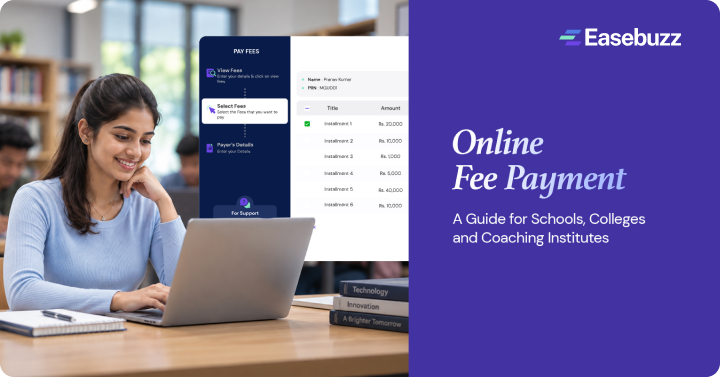
Online Fee Payment: A Guide for Schools, Colleges and Coaching Institutes
Payments - 10 Sept, 2026
-
Table of Contents
Online fee payment allows schools, colleges and coaching institutes to collect fees digitally through UPI, cards, net banking and other payment methods. But for an institution, moving fee collection online is about more than accepting payments. It also means managing fee structures, tracking dues, issuing receipts, reconciling transactions and giving parents a simpler way to pay.
For parents, the expectation is straightforward: choose a payment method, complete the payment and receive confirmation. For institutions, however, every payment needs to be mapped to the right student, fee head and installment, while accounts teams need accurate records of what has been collected, what is pending and what has been refunded.
That is where an online fee payment system becomes more than a payment page. It becomes part of the institution's fee collection and financial operations.
What Is Online Fee Payment?
Online fee payment is a digital transaction through which a student or parent pays an educational institution without visiting the institution or paying through cash or cheque. Depending on the platform, payments can be made using UPI, debit and credit cards, net banking, wallets, EMI options and recurring payment mandates.
Fees may include tuition, admission, transport, hostel, examination, activity or other institution-defined charges.
For an institution, the requirement goes beyond simply accepting money. A school with multiple classes, batches, fee heads and installment schedules may need to manage hundreds or thousands of individual payment records.
A good fee payment system connects the payment with the underlying student and fee record, so the institution can see what has been paid, what is due and which transactions still need attention.
Why Are Institutions Moving from Cash and Cheques to Online Fee Collection?
The shift towards online fee collection is largely an operational one.
Manual collection creates additional work for finance and administrative teams, particularly when payments come through different channels. Staff may need to match payments with students, update records, track outstanding amounts, issue receipts and reconcile bank statements.
Some of the common challenges include:
-

Reconciliation takes time: Payments received through different channels can require manual matching with student records and fee heads.
-
Tracking outstanding fees becomes difficult: Without a central dashboard, institutions may have limited visibility into pending, overdue or partially paid fees.
-
Installment collection requires follow-up: Parents may need reminders for every due date when recurring payment options are not available.
-
Discounts and concessions need to be managed accurately: Different students may have different fee structures or approved discounts.
-
Refunds can create additional administrative work: Failed, cancelled or excess payments need to be tracked and reconciled.
-
Multiple fee heads complicate accounting: Tuition, transport, hostel and other charges may need to be tracked separately.
For parents, online fee payment offers a simpler alternative: a payment page accessible from a phone or computer, multiple payment options and an immediate digital receipt or confirmation.
How Online Fee Payment Works
The process usually involves the following steps:
-
The institution defines its fee structure, including tuition, transport, hostel, activities and other applicable charges.
-
Fee amounts are assigned to students based on their class, batch, course, semester or other criteria.
-
The parent receives access to a payment page, portal or payment link showing the applicable amount.
-
The parent selects a payment method such as UPI, card, net banking or another available option and completes the transaction.
-
The payment is processed through the payment infrastructure and the transaction status is communicated to the institution.
-
The successful payment is recorded against the relevant student and fee record, while the institution can use its dashboard or integrated ERP to track collections and reconciliation.
The payment itself is only one part of the process. For an institution, what happens after the payment is equally important. Automatic reconciliation, payment status updates, receipts, refunds and reporting can determine how much manual work the accounts team still has to do.
Online Fee Payment Methods for Schools and Colleges?
| Method | Why it matters for fee collection |
|---|---|
|
|
A convenient option for everyday fee payments and smaller amounts. |
|
|
Useful for larger one-time payments such as admission or annual fees. |
|
|
Provides another option for parents who prefer direct bank payments. |
|
|
Useful for users who prefer wallet-based digital payments. |
|
|
Can be relevant for larger payments, subject to the institution's process and reconciliation requirements. |
|
|
Useful for recurring or installment-based fee collection where supported. |
|
|
Can help parents manage larger fee payments through eligible bank or card-based EMI options. |


Offering multiple payment options reduces dependence on a single payment method and gives parents more flexibility when paying school or college fees online.
For institutions collecting fees in installments, recurring payment options can also reduce the need to initiate a fresh payment for every due date, subject to the applicable mandate and authentication requirements.
What Should Institutions Know About Payment Compliance?
When an institution chooses an online fee payment provider, payment acceptance is only one consideration. Institutions should also understand how the provider handles regulatory requirements, security, payment data and transaction processing.
Check the Payment Aggregator's Authorisation
Institutions should verify the regulatory status of the payment provider they plan to use. Where a provider operates as a Payment Aggregator, its authorisation and compliance with applicable RBI requirements should be checked.
This is different from certifications such as PCI DSS. Payment security standards and regulatory authorisation address different areas, and one should not be treated as a substitute for the other.
Understand Card Tokenisation
Payment platforms handling card transactions must follow applicable RBI card tokenisation requirements. Tokenisation replaces the actual card number with a token for eligible use cases, reducing the need for merchants and payment platforms to retain sensitive card details.
For institutions that collect fees repeatedly, it is worth understanding how the payment provider handles saved payment credentials and recurring transactions.
Understand Recurring Payment Requirements
Institutions offering recurring fee collection through e-mandates should check how their payment provider handles mandate creation, authentication, notifications, modifications and cancellations under the applicable RBI framework.
Because regulatory requirements can change, institutions should rely on the provider's current compliance documentation rather than assumptions based on older payment practices.
Student Data and Online Fee Payment
An online fee payment system may process information such as a student's name, class, roll number, fee category and transaction details.
Educational institutions should therefore understand what student and parent information is collected, why it is collected, how it is stored and how it is protected.
Where personal data relating to children is involved, institutions should also assess their obligations under India's applicable data protection framework and confirm that their technology providers have appropriate processes in place.
This is particularly important when a fee platform is connected to admission forms, student management systems or other institutional workflows, because the payment journey may involve more information than the transaction itself.
Institutions should obtain appropriate legal and compliance guidance for their specific data-processing obligations.
Why Fee Heads Matter in Online Fee Collection
Educational institutions rarely collect only one type of fee.
A parent may make a single payment covering tuition, transport, hostel, examination or other charges. These amounts may have different accounting, reporting or tax treatment depending on the institution and the nature of the service.
A fee management system should therefore allow institutions to define and track different fee heads rather than treating every payment as one undifferentiated amount.
This makes it easier to understand collections, manage outstanding amounts, generate reports and reconcile transactions against the institution's records.
Online Fee Payment vs a Generic Payment Gateway
A payment gateway primarily provides the infrastructure required to process a digital payment.
A fee management or fee collection system addresses the additional operational requirements of an educational institution.
| Requirement | Generic Payment Gateway | Fee Management / Collection System |
|---|---|---|
|
Fee structure |
Payment amount linked to an order |
Student-wise, batch-wise or course-wise fee structures |
|
Installments |
Usually requires additional logic |
Built around installment-based collection |
|
Reconciliation |
Transaction/order-level |
Student and fee-head level |
|
Outstanding fees |
Requires separate system |
Designed to track pending and overdue payments |
|
Discounts |
May require external logic |
Can support institution-defined discounts or concessions |
|
Reporting |
Payment transaction reports |
Fee, collection and financial reports |
|
ERP integration |
Usually requires integration |
May provide dedicated education/ERP integrations |
|
Split payments |
Often requires additional setup |
Can support institution-defined payment splits |
|
Student records |
Not the primary focus |
Connected to fee and student records |
The right choice depends on the institution.
A small coaching institute collecting occasional one-time payments may only require a payment gateway. A school or university managing multiple batches, fee heads, installments, discounts, refunds and reconciliation may benefit from a more comprehensive fee management system.
What to Check Before Choosing an Online Fee Payment System?
Before selecting a fee payment partner, institutions should evaluate more than the payment methods available at checkout.
Consider these questions:
-
Is the payment provider appropriately authorised and compliant for the services it offers?
-
Does the system support UPI, cards, net banking and other relevant payment methods?
-
Can the institution create and manage different fee structures and installments?
-
Can payments be automatically mapped to the right student and fee head?
-
Does the system provide real-time payment and collection visibility?
-
Can it track pending, overdue and partially paid fees?
-
Does it support automated payment reminders and digital receipts?
-
Can it manage refunds and failed transactions?
-
Does it integrate with the institution's ERP or accounting software?
-
Can it generate detailed collection, settlement and reconciliation reports?
-
Does it support recurring payments where required?
-
How does the provider handle student, parent and payment data?
The answers to these questions can make a significant difference to the amount of manual work involved in day-to-day fee collection.
Online Fee Payment and Collection With FeesBuzz
FeesBuzz is Easebuzz's fee management and online fee collection solution for educational institutions, including schools, colleges, universities and coaching institutes.
It is designed to help institutions manage the fee collection lifecycle alongside payment processing. Institutions can create fee structures, manage installments, track collections and view payment activity through a central dashboard.
FeesBuzz supports 150+ payment modes, including UPI, cards, net banking, wallets and other available payment options. It also supports recurring collection through e-NACH and UPI-based mandates, where applicable.
For institutions, the system brings together several parts of the fee collection process:
-
Online fee collection across multiple payment methods
-
Batch-wise and course-wise fee management
-
Installment-based fee collection
-
Fee discounts and concessions
-
Real-time payment and collection tracking
-
Automated reconciliation and settlement visibility
-
Payment reminders through digital communication channels
-
Refund management
-
Defaulter and outstanding fee tracking
-
Split payments for applicable institutional requirements
-
Reporting and MIS
-
Integration with accounting and ERP systems such as Tally
The objective is simple: reduce the manual effort involved in collecting, tracking and reconciling educational fees while giving parents a more convenient way to pay.
Easebuzz also offers AI Forms, powered by its ERA engine, for institutions that want to connect forms and payments in workflows such as admissions and registrations. This can help bring data collection and payment into a single digital journey instead of managing them as separate processes.
FAQ's
Is it safe to pay school or college fees online in India?
Online fee payment can be a secure way to pay when the institution uses an appropriately authorised and compliant payment provider and follows applicable security and data-protection practices. Parents should use the official payment link or portal provided by their school, college or coaching institute and verify the payment confirmation after completing the transaction.
Do parents have to pay an additional fee for online fee payment?
It depends on the institution, payment method and terms agreed with the payment provider. Some institutions may absorb payment-related charges, while others may apply a convenience fee for certain payment methods. Parents should check the payment page before completing a transaction.
Is GST charged on school or college fees paid online?
Core tuition fees at a recognised educational institution are exempt from GST. Ancillary charges bundled into the same payment - transport, hostel, meals, certain activities - may not carry the same exemption, depending on how the institution has structured its fee heads. This is a reason institutions should keep fee heads clearly separated in their payment system rather than collecting one lump "fees" amount.
What happens if money is debited but the fee payment shows as failed?
This is one of the most common fee payment complaints, and it's usually a timing issue rather than a lost payment - the bank has debited the amount, but the confirmation from the payment gateway to the institution's system hasn't come through yet.
Authorised payment aggregators are required to reconcile and reverse or complete such transactions within a defined window; if a receipt doesn't appear within a couple of working days, the institution's accounts office (not the bank) is usually the right first point of contact, since the payment aggregator reports transaction status to them.
Can school and college fees be paid through UPI?
Yes. UPI is one of the commonly used digital payment methods for online fee payment in India. Availability can vary depending on the institution's payment provider and configuration.
Can school or college fees be paid in installments?
Yes. Institutions can structure fees into installments based on their academic or administrative requirements. Depending on the payment platform, parents may be able to pay installments using standard payment methods or recurring payment options such as eligible e-NACH or UPI-based mandates.
What happens if money is debited but the fee payment shows as failed?
A payment can sometimes remain pending or show as failed even after the payer's bank account has been debited. In such cases, the transaction needs to be checked against the payment status and the institution's records. Parents should retain the transaction reference and contact the institution through its official support channel if the payment confirmation or refund does not arrive within the applicable timeline.
Does an institution need RBI approval to collect fees online?
An educational institution does not generally need to become a Payment Aggregator simply to accept online fees through a payment provider. The institution should, however, verify that the provider it uses is appropriately authorised for the payment services it offers and meets applicable regulatory requirements.
What is the difference between a payment gateway and a fee management system?
A payment gateway primarily enables digital payment processing. A fee management system adds education-specific functionality such as student-wise fee tracking, installments, fee heads, discounts, outstanding payments, reconciliation, reporting and ERP integration.
For institutions with more complex fee structures, combining payment processing with fee management can reduce the need to maintain separate systems and manual processes.
Share:


Related Posts

Cross-Border Payments: A 2026 Guide for Exporters, SaaS Businesses & Freelancers
Payments - 3 Sept, 2026

Agentic AI in Payments: The Future of Digital Payments
Payments - 10 Sept, 2026