CATEGORY - PAYMENTS
Multiple Payment Gateways: How They Work, Benefits & How to Choose
Payments - 26 Sept, 2026
-
Table of Contents
For an online business, the payment experience can directly affect whether a customer completes a purchase or abandons the checkout.
While a single payment gateway can provide everything a business needs to accept online payments, growing businesses may consider integrating multiple payment gateways to improve payment availability, support different payment methods, create backup routes and serve customers across different markets.
But using multiple payment gateways is not automatically the right solution for every business.
The real question is: When does a business need multiple payment gateways, how should transactions be routed, and what should you evaluate before adding another payment provider?
This guide explains how multiple payment gateways work, their advantages and challenges, routing strategies, and the key factors businesses should consider when building a scalable payment infrastructure.
What Is a Multiple Payment Gateway?
A payment gateway is a technology layer that enables businesses to accept and process digital payments from customers. It connects the checkout experience with the relevant payment infrastructure to securely process transactions.
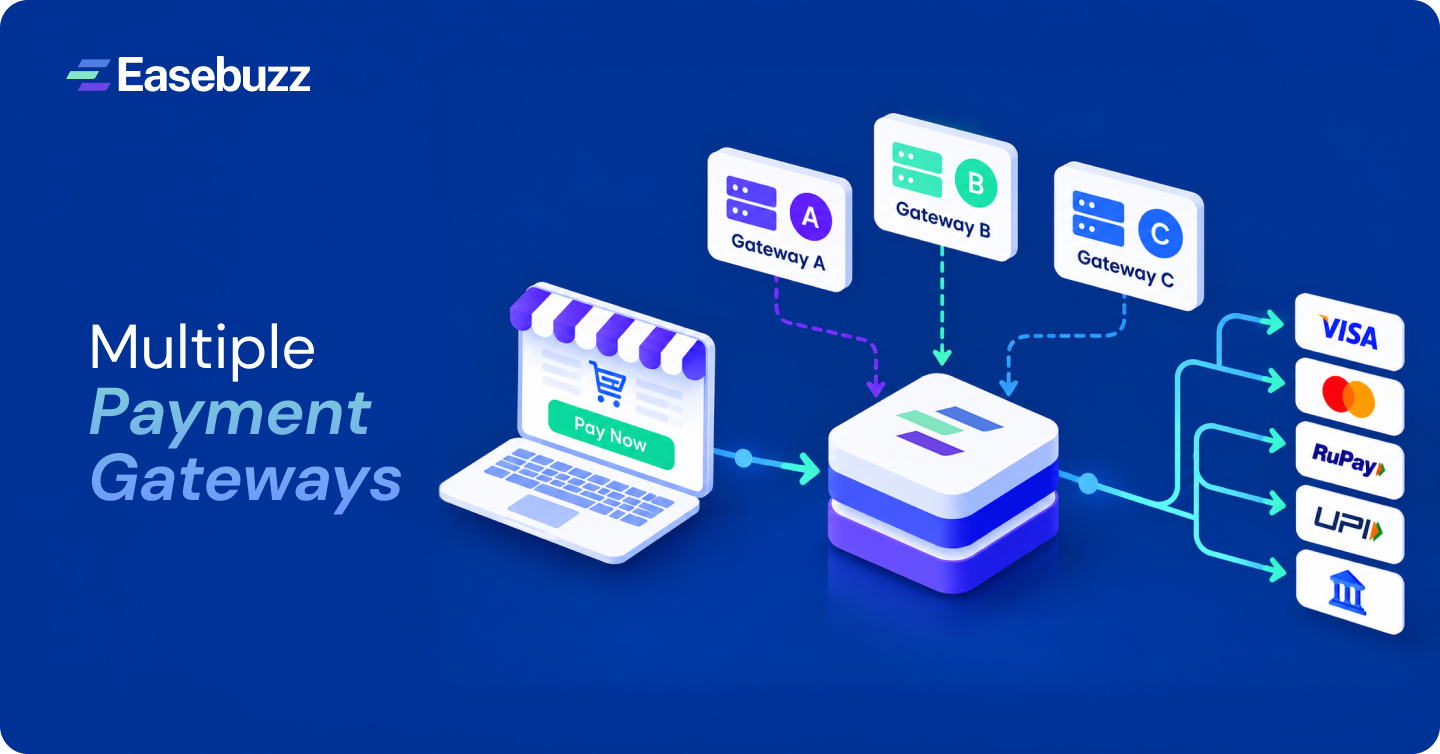
A multiple payment gateway setup means a business uses two or more payment gateway providers to process online transactions.
For example, an eCommerce business could integrate:
-

Payment Gateway A for UPI and domestic cards
-
Payment Gateway B for international transactions
-
Payment Gateway C as a backup when another gateway experiences an outage
The gateways can either be presented separately to customers or managed behind the scenes through a payment routing or orchestration layer.
How are they set up?
Two common approaches
1. Parallel payment gateways: The business integrates multiple gateways and allows customers or the platform to select a particular payment option or route.
2. Selective payment routing: The business uses routing logic to automatically determine which gateway should process a particular transaction.
For example, routing could consider:
-
Payment method
-
Issuing bank
-
Card network
-
Customer location
-
Transaction value
-
Currency
-
Gateway availability
-
Historical transaction performance
The second approach can provide greater control, but it also requires more technical planning.
Why Do Businesses Use Multiple Payment Gateways?
Businesses typically consider multiple gateways for one or more of these reasons:
-
Business continuity: If one payment provider experiences downtime or a technical issue, another available payment route can help reduce disruption.
-
Payment method coverage: Different providers may support different payment methods, banks, currencies or payment experiences.
-
International expansion: Businesses serving customers in multiple countries may need payment infrastructure that supports international cards, currencies and cross-border payment requirements.
-
Payment performance optimisation: A business may analyse transaction performance by payment method, bank, geography or gateway and use that information to improve routing decisions.
-
Risk diversification: Depending on one payment provider creates a single point of dependency. Multiple providers can distribute that dependency.
However, adding another gateway also adds integration, operational and reconciliation complexity. Therefore, businesses should evaluate the business case before implementing a multi-gateway setup.
How Do Multiple Payment Gateways Work?
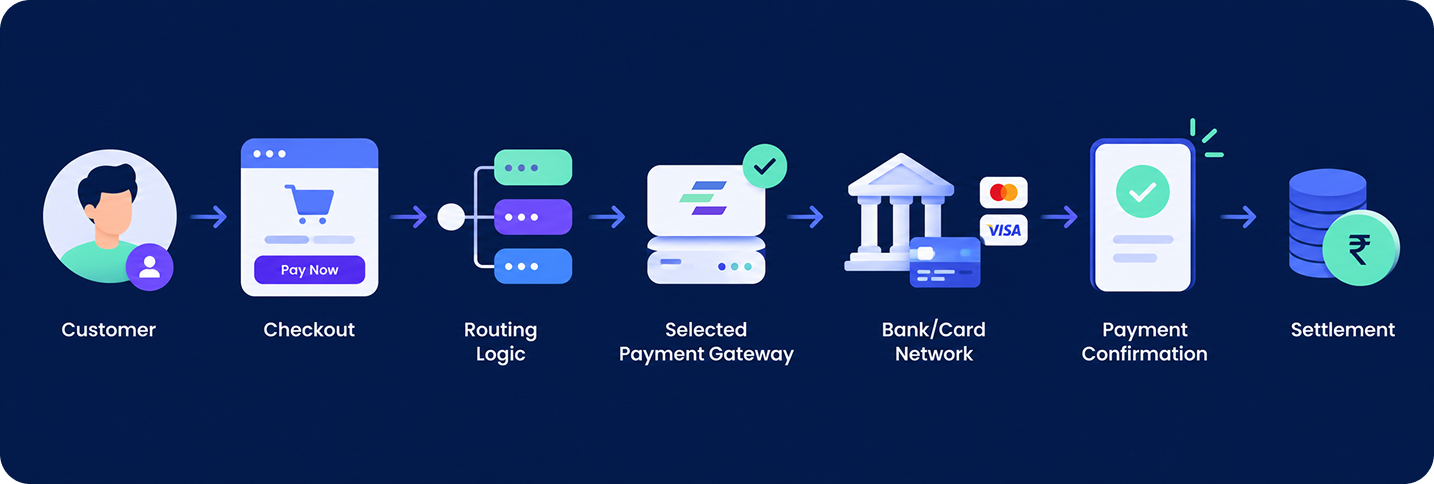
Here's what happens step by step.
Step 1: Customer initiates payment
The customer reaches the checkout page and selects a payment method such as UPI, credit card, debit card, net banking, EMI or another supported option.
Step 2: Routing logic evaluates the transaction
If the merchant has a routing layer, predefined rules or optimisation logic determine which payment gateway should process the transaction.
Step 3: Transaction is sent to the selected gateway
The payment request is securely sent to the selected payment gateway through an API or SDK integration.
Step 4: Payment is authenticated
Depending on the payment method, the transaction may involve the customer's bank, card network, issuer or other payment participants.
Step 5: Transaction succeeds or fails
The gateway returns the transaction status to the merchant's system.
Step 6: Fallback or retry may be triggered
Where the architecture supports it, a failed or unavailable route may trigger an alternative payment route, subject to the payment state and gateway capabilities.
Step 7: Payment is reconciled and settled
The transaction status, settlement information, refunds and other payment events need to be recorded and reconciled with the merchant's internal systems.
How to Integrate Multiple Payment Gateways
Integrating multiple payment gateways requires more than adding multiple checkout buttons.
Businesses need to plan the complete payment lifecycle, including transaction initiation, authentication, callbacks, refunds, reconciliation, settlements and failure handling.
-
Define the business requirement
First determine why you need multiple gateways.
For example:
-
International payment acceptance
-
Backup payment processing
-
Higher payment availability
-
Different payment methods
-
Multiple business entities
-
Marketplace or platform payments
-
Geographic routing
Without a clear objective, adding another gateway can increase complexity without creating meaningful business value.
-
-
Complete merchant onboarding
Each payment provider may have its own onboarding, KYC, commercial and technical requirements.
Make sure the required payment methods and transaction types are enabled before development begins.
-
Review APIs and SDKs
Evaluate:
-
API documentation
-
SDK availability
-
Authentication
-
Webhooks
-
Payment status APIs
-
Refund APIs
-
Settlement APIs
-
Error codes
-
Sandbox environment
Developer-friendly APIs can significantly reduce integration and maintenance effort.
-
-
Build a common payment layer
Instead of creating completely separate payment flows throughout your application, consider building a common abstraction layer.
Your application should ideally be able to send a transaction request without needing to understand every provider-specific implementation.
-
Create routing rules
Routing logic can consider parameters such as:
-
Payment method
-
Issuing bank
-
Card network
-
Currency
-
Geography
-
Transaction amount
-
Transaction status APIs
-
Gateway availability
-
-
Handle webhooks and payment states
Payment processing is asynchronous in many scenarios.
Your system should correctly handle events such as:
-
Success
-
Failure
-
Pending
-
Refund
-
Refund failure
-
Cancellation
-
Settlement
-
Chargeback or dispute events, where applicable
-
-
Test before going live
Test every gateway independently and then test the complete multi-gateway flow.
Important scenarios include:
-
Successful payment
-
Failed payment
-
Pending payment
-
Duplicate transaction
-
Timeout
-
Webhook failure
-
Refund
-
Partial refund
-
Gateway downtime
-
Customer closing the checkout window
-
Amount debited but merchant order not updated
-
-
Monitor continuously
Once live, monitor:
-
Payment success rate
-
Failure rate
-
Gateway response time
-
API errors
-
Payment method performance
-
Refund status
-
Settlement reconciliation
-
Downtime
-
Transaction discrepancies
-
Advantages of Using Multiple Payment Gateways
-
Greater payment availability
Having an alternative payment route can help businesses reduce dependency on a single provider.
If one route becomes temporarily unavailable, another configured route may be available depending on the payment method and transaction conditions.
-
Wider payment method coverage
Customers have different payment preferences.
A broader payment stack can support methods such as:
-
UPI
-
Credit cards
-
Debit cards
-
Net banking
-
Wallets
-
EMI
-
BNPL
-
Recurring payments
Easebuzz, for example, currently supports 150+ payment options across categories including UPI, cards, net banking, wallets, EMI and BNPL.
-
-
Support for international customers
Businesses expanding beyond India may need payment infrastructure designed for international transactions.
Easebuzz provides international payment capabilities, including accepting international payments in INR and cross-border payment services.
However, businesses should always evaluate the countries, currencies, payment methods and compliance requirements relevant to their own business.
-
Business continuity
Payment infrastructure is a critical part of an online business.
A well-designed multi-gateway architecture can provide additional resilience by reducing dependence on a single processing route.
-
More control over payment performance
With appropriate transaction-level data, businesses can identify patterns in:
-
Bank-wise failures
-
Payment-method failures
-
Gateway performance
-
Card networks
-
Transaction values
This data can then inform routing and checkout optimisation.
-
Challenges of Using Multiple Payment Gateways
Multiple gateways can solve certain problems, but they also introduce additional complexity.
-
More technical integrations
Every additional gateway can mean another API, SDK, webhook structure, authentication mechanism and set of error codes to manage.
-
More complex reconciliation
When transactions are distributed across multiple providers, finance teams need a consolidated view of:
-
Transactions
-
Settlements
-
Refunds
-
Fees
-
Failed payments
-
Disputes
-
Settlement discrepancies
Without proper reconciliation processes, this can become difficult to manage at scale.
-
-
Multiple dashboards
Each payment provider may have its own dashboard, reporting structure and settlement cycle.
Teams may therefore need additional internal reporting or reconciliation systems.
-
More operational dependencies
Multiple gateways mean multiple:
-
Contracts
-
Commercial arrangements
-
Support teams
-
Technical integrations
-
Compliance processes
-
-
Complex failure handling
A payment failure does not always mean the transaction can simply be sent to another gateway.
For example, if a customer's account has already been debited, blindly retrying through another route could create a duplicate-payment risk.
Failover therefore needs to be designed around the actual payment state, not just an error response.
-
Higher maintenance effort
Gateway APIs, payment methods, regulations and technical specifications can change over time.
A multi-gateway architecture needs ongoing monitoring and maintenance.
When Should a Business Consider Multiple Payment Gateways?
Not every merchant needs two or more payment gateways.
A single comprehensive payment gateway may be sufficient when:
-
The business operates primarily in one market
-
Existing payment methods meet customer requirements
-
Payment performance is satisfactory
-
The provider offers adequate support
-
Reconciliation is straightforward
-
There is no significant business continuity requirement
Multiple gateways may become more relevant when:
-
Transaction volumes are significant
-
Payment failures have a material business impact
-
The business operates across multiple markets
-
Different payment methods require different processing capabilities
-
The business needs additional redundancy
-
The organisation has the technical resources to manage multiple providers
The decision should therefore be based on business requirements rather than simply adding more payment providers.
What Features Should You Look for in a Multiple Payment Gateway?
Whether you choose one gateway or multiple providers, evaluate the following capabilities.
-
Wide payment method coverage
Look for support across the payment methods your customers actually use.
Easebuzz supports 150+ payment options, including UPI, cards, net banking, wallets, EMI and BNPL.
-
Developer-friendly APIs
Good API documentation, SDKs, sandbox environments and webhook support can simplify implementation.
Easebuzz provides developer-focused APIs and integration documentation for payment acceptance.
-
Security and compliance
Payment infrastructure should follow applicable security and regulatory requirements.
Easebuzz states that its payment platform is PCI DSS Level 1 compliant and operates as an RBI-authorised Payment Aggregator.
-
Payment performance visibility
A payment gateway should give merchants useful visibility into transaction performance rather than only showing whether an order succeeded or failed.
Look for reporting around:
-
Payment status
-
Payment method
-
Transaction failures
-
Refunds
-
Settlements
-
Transaction trends
-
-
Reconciliation
Automated reconciliation can reduce manual finance work and help identify payment-status or settlement discrepancies.
Easebuzz provides automated reconciliation and dashboard-based transaction management.
-
Refund management
The ability to initiate and track refunds through APIs or a dashboard is important for eCommerce and other high-volume businesses.
-
Recurring payments
Subscription-based businesses should evaluate support for recurring payment workflows such as UPI mandates and eNACH.
Easebuzz supports recurring payment capabilities through UPI and eNACH-based solutions.
-
International payments
If your business serves international customers, evaluate:
-
Supported countries
-
Supported currencies
-
International cards
-
Settlement currency
-
Cross-border compliance
-
Refund capabilities
-
-
Checkout experience
The payment page should be fast, mobile-friendly and easy to navigate.
A gateway should also provide options for businesses that want to customise or embed their checkout experience.
-
Support
Payment issues can directly affect revenue.
Evaluate the provider's technical support channels, response process and escalation mechanisms before going live.
What Is Payment Routing?
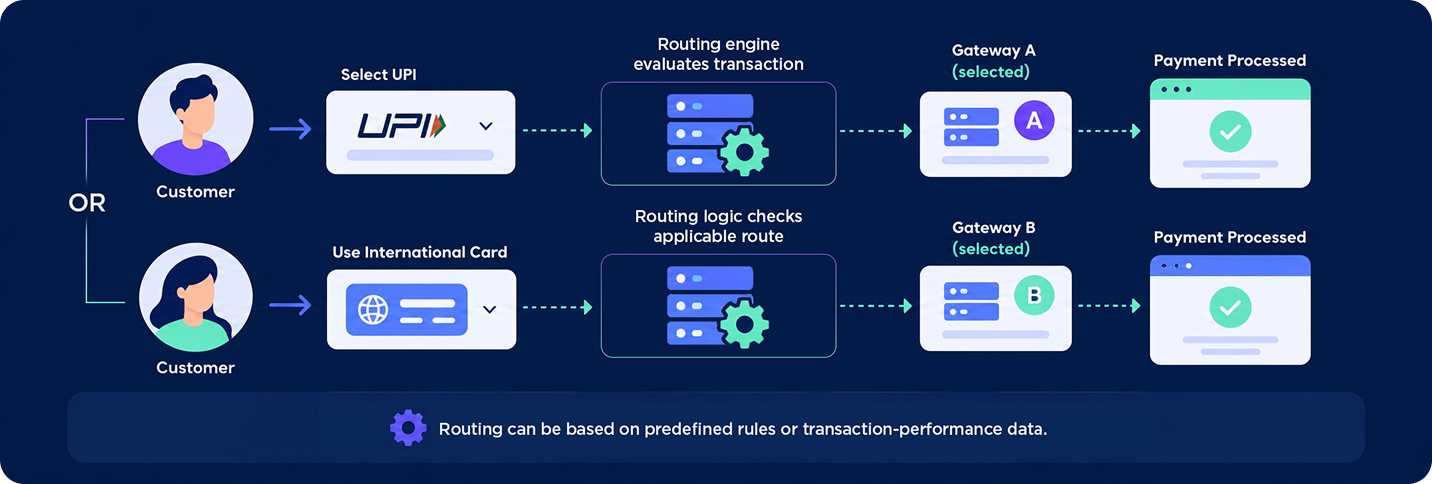
Payment routing is the process of deciding which payment processing route should handle a transaction.
For businesses using multiple payment gateways, routing acts as the decision layer between the merchant's application and the available payment providers.
For example:
How Does Payment Routing Work?
A simplified routing architecture looks like this:
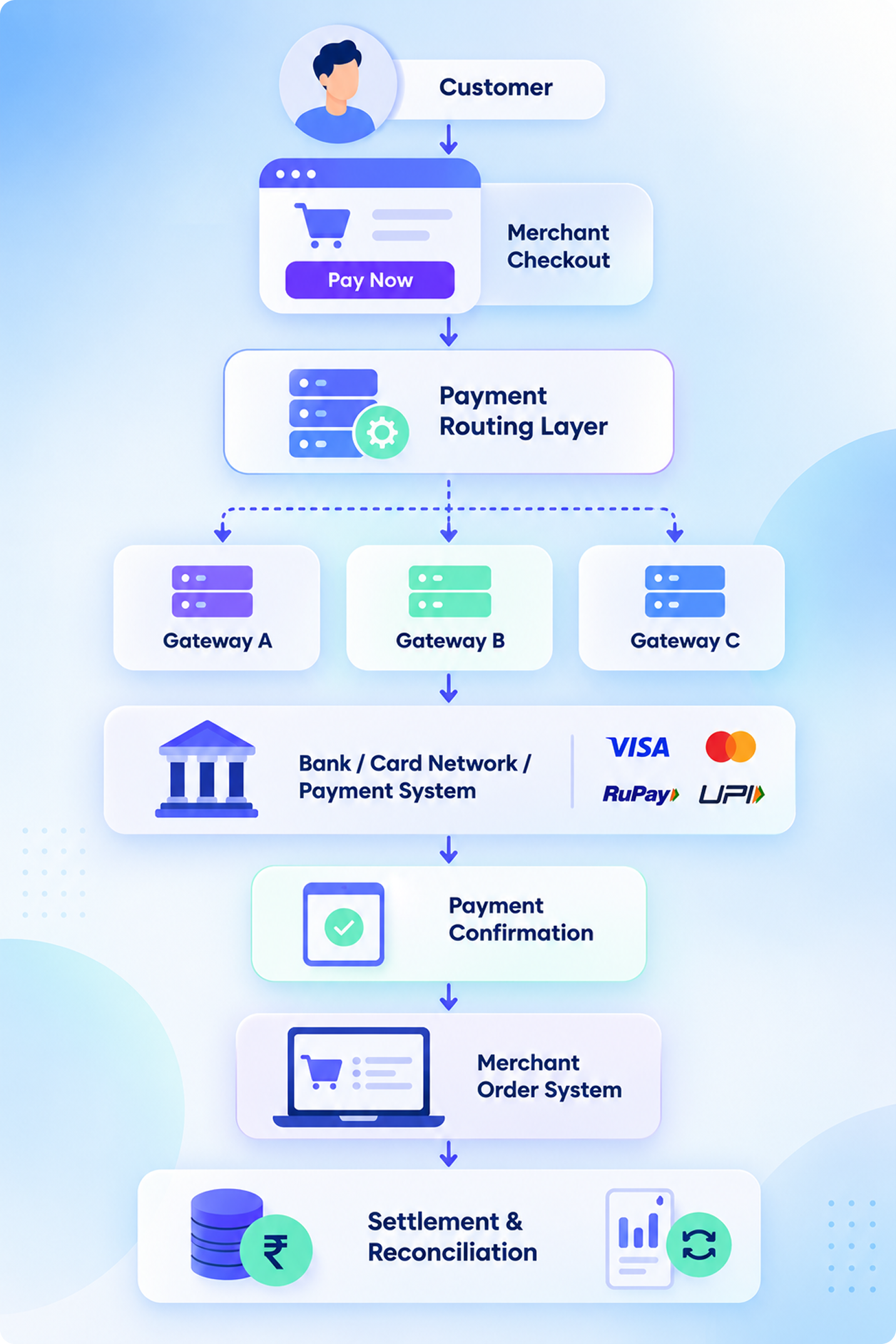
The objective is not simply to use more gateways.
The objective is to select an appropriate payment route for each transaction while maintaining a consistent customer experience.
Key Factors for Effective Payment Routing
-
Payment method: The selected payment method can determine which processing route is suitable.
For example, routing logic may differentiate between UPI, cards, net banking and other methods.
-
Issuing bank: Card or banking performance can vary by issuer. Businesses with sufficient transaction data can use issuer-level performance as one routing input.
-
Card network: Visa, Mastercard, RuPay and other networks may have different processing characteristics.
-
Geography: Customer location and transaction origin can influence the most suitable payment route, particularly for international businesses.
-
Currency: International transactions may require specific currency and cross-border capabilities.
-
Gateway availability: Real-time monitoring can help identify unavailable routes and prevent transactions from being sent to a known-down service.
-
Transaction value: Some businesses may create different routing rules for low-value and high-value transactions.
-
Historical performance: Historical transaction data can help identify which routes perform better for particular combinations of payment methods, issuers or geographies.
Rule-Based vs Success-Based Routing
There are two broad approaches to payment routing.
Rule-Based Routing
Rule-based routing uses predefined conditions.
For example:
IF payment method = UPI
AND customer location = India
THEN use Gateway A.
Another example:
IF currency = USD THEN use the gateway configured for that international payment flow.
Benefits
-
Easy to understand
-
Easy to audit
-
Predictable
-
Gives businesses direct control
Limitations
-
Requires ongoing rule maintenance
-
Static rules may not react to changing transaction performance
-
Complex businesses can end up with many routing conditions
Performance-Based Routing
Performance-based routing uses transaction data to inform routing decisions.
The system can analyse factors such as:
-
Historical success rates
-
Payment method
-
Issuer
-
Gateway response
-
Transaction patterns
-
Availability
The routing logic can then direct transactions towards an available route based on configured business and performance criteria.
The important point is that businesses should not treat routing as a simple “send failed payment to another gateway” mechanism. Payment status, duplicate-payment risk and the exact failure condition need to be considered.
Multiple Payment Gateways vs Multiple Payment Methods
These concepts are often confused.
Multiple payment methods
A business offers customers several ways to pay through a payment gateway.
For example:
One gateway → UPI + Cards + Net Banking + Wallets + EMI + BNPL
Multiple payment gateways
A business uses more than one payment provider.
For example:
Merchant → Gateway A + Gateway B + Gateway C
A business can therefore have one payment gateway with many payment methods, without needing multiple gateways.
This distinction is important because adding another provider may not solve a problem that can already be addressed by expanding payment-method coverage.
Can One Payment Gateway Support Multiple Merchant Accounts?
In some business models, a single payment platform can support multiple merchant accounts, sub-merchants or business entities, depending on the provider's capabilities and applicable onboarding requirements.
This can be useful for:
-
Marketplaces
-
SaaS platforms
-
Franchise businesses
-
Multi-brand businesses
-
Agencies
-
Platforms managing multiple sellers
For example, Easebuzz provides sub-merchant creation and management capabilities for applicable platform and SaaS use cases.
However, the exact account structure, onboarding process and settlement model depend on the business model and payment provider.
How Easebuzz Supports Scalable Payment Operations
For businesses evaluating payment infrastructure, Easebuzz provides a broad payment acceptance stack that can address many requirements that otherwise lead businesses to consider multiple payment providers.
-
150+ payment options
Easebuzz supports 150+ payment options across UPI, cards, net banking, wallets, EMI, BNPL and other payment methods.
-
Developer-friendly integration
Businesses can integrate payment acceptance using APIs, SDKs and plugins supported by detailed documentation.
-
Unified payment visibility
Easebuzz provides a dashboard for transaction tracking, refunds, reporting and payment operations.
-
Automated reconciliation
Payment and settlement data can be reconciled through supported workflows, helping businesses reduce manual payment operations.
-
Recurring payments
Businesses with subscription or recurring collection requirements can use UPI and eNACH-based payment capabilities.
-
International payment capabilities
Easebuzz supports international payment acceptance and cross-border payment services for eligible businesses.
-
RBI-authorised Payment Aggregator
Easebuzz received RBI authorisation to operate as an Online Payment Aggregator in February 2025 and subsequently received authorisation covering online, offline and cross-border payment aggregation in November 2025.
The result is that businesses should first assess whether a single, comprehensive payment platform can meet their requirements before introducing the technical and operational complexity of multiple payment gateways.
Conclusion
Multiple payment gateways can be useful for businesses that require additional payment routes, geographic coverage, redundancy or more control over transaction routing.
But more payment gateways do not automatically mean better payments.
A well-designed payment infrastructure should focus on the complete payment journey - from checkout and transaction processing to payment confirmation, refunds, settlements and reconciliation.
For many businesses, the first step should be to evaluate whether their existing payment gateway provides sufficient payment-method coverage, reliability, APIs, reporting, reconciliation and support.
For businesses with more complex requirements, multiple gateways combined with appropriate routing and monitoring can provide additional flexibility.
The right approach is ultimately the one that balances payment availability, customer experience, technical complexity, operational control and business scalability.
With its 150+ payment options, developer-friendly APIs, automated reconciliation, payment dashboard, recurring payment capabilities and international payment solutions, Easebuzz provides businesses with a comprehensive payment infrastructure for accepting and managing digital payments at scale.
FAQ's
Is it better to have multiple payment gateways?
It depends on the business. Multiple gateways can provide redundancy, payment-method coverage and routing flexibility, but they also increase integration, reconciliation and operational complexity.
Businesses should compare the benefits against the additional maintenance required.
Can I integrate two payment gateways on one website?
Yes. A website or application can be architected to work with multiple payment gateways, provided the relevant providers support the required integration and the merchant completes their onboarding and compliance requirements.
Does having multiple payment gateways increase payment success rates?
Not automatically. Multiple gateways can provide additional processing routes, but the outcome depends on how transactions are routed, the payment methods supported, gateway performance, customer behaviour and the merchant's technical implementation.
What is payment gateway routing?
Payment gateway routing is the process of selecting which payment gateway or processing route should handle a transaction based on predefined rules or transaction-performance data.
Is payment orchestration the same as using multiple payment gateways?
Not exactly. Multiple payment gateways refer to the use of several payment providers.
Payment orchestration generally refers to the technology layer used to connect, manage and route transactions across multiple payment providers and payment services.
Can multiple payment gateways improve international payment acceptance?
They can, depending on the providers and markets involved.
Businesses should evaluate supported countries, currencies, payment methods, cross-border capabilities, compliance requirements and settlement processes.
What should I consider before adding another payment gateway?
Consider:
-
Why you need another provider
-
Payment method coverage
-
International requirements
-
Transaction performance
-
Downtime and resilience
-
Integration effort
-
Reconciliation
-
Settlement processes
-
Refund handling
-
Technical support
-
Total cost of ownership
Share:


Related Posts
Agentic AI in Payments: The Future of Digital Payments
Payments - 10 Sept, 2026
Online Fee Payment: A Guide for Schools, Colleges and Coaching Institutes
Payments - 10 Sept, 2026