CATEGORY - PAYMENTS
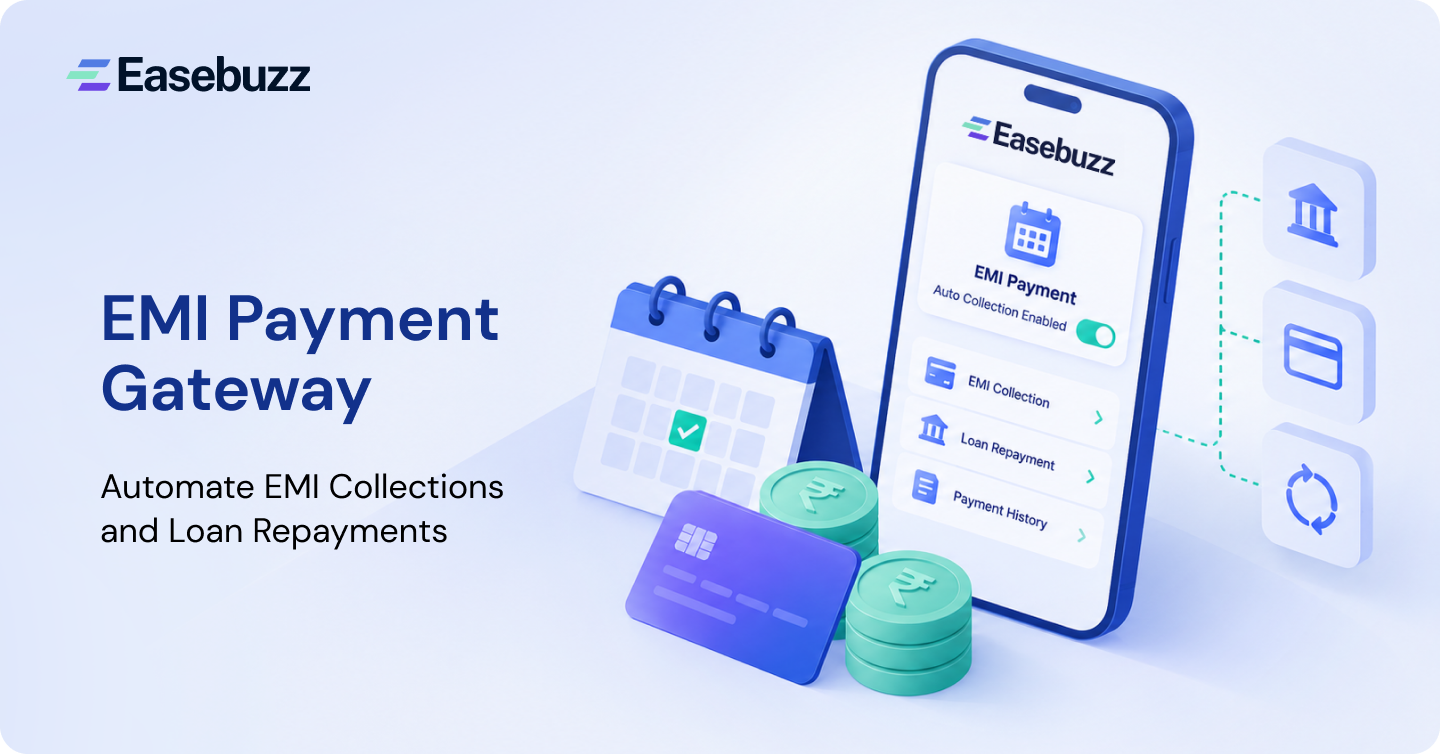
EMI Payment Gateway: Automate EMI Collections and Loan Repayments
Payments - 10 Sept, 2026
-
Table of Contents
For lenders, NBFCs, fintech platforms, and businesses offering instalment-based payments, collecting EMIs at scale can become difficult when repayments depend on manual reminders, one-off payment requests, and spreadsheet-based reconciliation.
An EMI payment gateway provides the payment infrastructure businesses can use to accept, process, track, and reconcile digital EMI payments. Depending on the setup, it can support recurring mandates, digital payment acceptance, transaction tracking, payment status updates, and reconciliation, helping businesses reduce manual intervention across the repayment cycle.
EMI payments generally fall into two different use cases. The first is loan EMI collection, where a lender collects scheduled repayments from an existing borrower. The second is purchase EMI, where a customer chooses to pay for a purchase in installments at checkout. While both involve EMI payments, their payment flows, eligibility, mandates, and business requirements are different.
This article explains how an EMI payment gateway works, how it can simplify loan repayments, the difference between EMI collection and EMI at checkout, and what businesses should consider when choosing an EMI payment solution.
What is an EMI Payment Gateway?
An EMI payment gateway is payment infrastructure that enables lenders, NBFCs, fintech platforms, and businesses to collect or facilitate EMI payments digitally.
For loan repayments, the payment flow can connect the borrower, lender, bank, and relevant payment network or mandate infrastructure. Depending on the setup, a borrower may make a one-time digital payment for a specific installment or authorise recurring payments through an eligible mandate.
The key difference from a standard one-time payment is that EMI collection is designed around a scheduled repayment cycle. Instead of asking the customer to enter payment details every month, an eligible recurring mandate can authorise future payments according to the applicable terms.
Common payment mechanisms can include UPI-based recurring mandates, e-NACH, or eligible card-based recurring payment arrangements. The exact payment method, authentication requirements, limits, and notification requirements depend on the payment instrument and applicable rules.
For purchasing on EMI, the flow is different. The customer selects an EMI option during checkout, and the relevant bank or financial institution determines eligibility and applicable terms before the transaction is authorised.
Loan EMI Collection vs EMI at Checkout
| Loan EMI Collection | Purchase EMI at Checkout | |
|---|---|---|
|
What happens? |
A lender collects a scheduled repayment on an existing loan |
A customer converts a purchase into installments |
|
Who initiates it? |
The lender or its collection system |
The customer at checkout |
|
Typical payment flow |
Recurring mandate or one-time digital repayment Cards |
Card EMI, cardless EMI, BNPL, or other eligible financing option |
|
Main objective |
Collect repayments on time |
Make a purchase easier to finance |
|
Example |
Monthly repayment on a personal loan |
Customer purchasing a laptop through 6-month EMI |
The underlying payment infrastructure can overlap, but the business workflow, eligibility, mandate structure, and customer journey are different.
How Does an EMI Payment Gateway Work?
The exact flow depends on whether the payment is a loan repayment or a purchase EMI. For recurring loan collections, the process generally involves the following steps.
Step 1: Set up the payment or mandate: The borrower can make a one-time payment for an EMI or, where supported and eligible, authorise a recurring mandate for future repayments.
Step 2: Payment is initiated: For a scheduled collection, the lender or its collection system initiates the payment according to the applicable repayment schedule and mandate terms.
Step 3: Payment is authorised and processed: The payment request is routed through the relevant payment infrastructure to the customer's bank or payment method. The transaction is then approved or declined based on applicable checks, mandate conditions, limits, and account availability.
Step 4: Payment status is updated: The payment gateway returns the transaction status to the business or its integrated system. Customers can also receive the relevant payment confirmation through the applicable communication channel.
Step 5: Payment is tracked and reconciled: The transaction can then be mapped against the relevant loan account, invoice, or customer record. Automated transaction data and reconciliation can reduce the need for finance teams to manually match individual payments against bank statements.
The benefit of this workflow is not simply that customers can pay online. It can help businesses create a more consistent collection process with better visibility into successful, pending, and failed payments.
Why Automate EMI Collections?
Manual EMI collection becomes increasingly difficult as the number of borrowers grows.
A collections team may need to monitor due dates, send reminders, follow up on missed payments, verify incoming transactions, update borrower records, and reconcile payments across different channels. Managing these activities manually can increase operational effort and make it harder to identify which payments actually need human intervention.
Automating the payment layer can help address several of these challenges.
-

Reduce routine collection effort: Recurring payment mechanisms can reduce the need to manually request every scheduled repayment, allowing collection teams to focus more on exceptions and overdue accounts.
-
Improve payment visibility: A centralised payment view can help teams track transactions and identify successful, pending, or failed payments without relying entirely on separate spreadsheets or bank statements.
-
Simplify reconciliation: When transaction information is integrated with the relevant business or lending system, payments can be mapped to the appropriate account or reference, reducing manual reconciliation work.
-
Make repayments more convenient: Borrowers can make payments through digital payment methods instead of depending on branch visits, cheques, or manual payment processes.
-
Respond faster to failed payments: When transaction status is available quickly, collection teams can identify failed payments and take the appropriate next action instead of discovering them much later during manual reconciliation.
Support growing transaction volumes: Automated payment infrastructure can help businesses handle larger numbers of recurring transactions without increasing manual collection activity at the same rate.
The objective is not to eliminate the collections function. It is to automate repetitive payment and tracking activities so teams can spend more time on cases that require intervention.
How Does EMI Collection Software Simplify Loan Repayments?
An EMI collection setup usually involves more than the payment gateway itself.
The payment gateway handles payment processing, while the lender's loan management system, collection platform, CRM, or other business systems may manage repayment schedules, borrower information, collection workflows, and account-level activities.
When these systems are connected through APIs, the payment layer can become part of a broader automated collection workflow.
Depending on the technology setup, this can include:
-
Scheduled payment requests
-
Recurring payment mandates
-
Payment status tracking
-
Payment reminders and notifications
-
Failed-payment monitoring
-
Transaction reporting
-
Automated reconciliation
-
Integration with LMS, CRM, ERP, or billing systems
This distinction is important. A payment gateway does not necessarily replace a lender's loan management or collection software. Instead, it provides the payment infrastructure those systems can use to accept and track digital repayments.
Payment Gateway with EMI Option: What Businesses Should Know
A payment gateway with an EMI option generally refers to a checkout experience where customers can choose to pay for a purchase through installments.
This is different from collecting an EMI on a loan that has already been disbursed.
For example, a customer purchasing a ₹60,000 appliance may choose an eligible six-month EMI option at checkout instead of paying the entire amount upfront.
EMI options can be useful for businesses selling higher-value products or services, including:
-
Consumer electronics
-
Furniture and appliances
-
Education and professional courses
-
Healthcare services
-
Travel
-
Real estate-related payments
-
Other high-value purchases
The availability of EMI depends on the financing arrangement, customer eligibility, participating banks or financial institutions, purchase value, tenure, and applicable terms. Businesses should therefore look beyond simply having an “EMI” option at checkout and evaluate which EMI methods, banks, tenures, and offers are actually available for their customers.
Debit / Credit Card EMI Payment Gateway: How Does It Work?
Debit and credit card EMI options allow eligible customers to convert the cost of a purchase into installments using a qualifying card.
At checkout, the customer selects the relevant card EMI option and enters or selects the eligible payment method. The payment request is securely routed through the payment infrastructure to the relevant issuing bank, which determines whether the customer and card qualify for the available EMI option.
The payment gateway facilitates the transaction and routing between the merchant, payment network, and relevant financial institution. It does not independently determine the customer's EMI eligibility or financing terms.
Businesses should also remember that eligible banks, available tenures, minimum transaction values, interest or other applicable charges, and offer terms can vary by issuer and merchant arrangement.
Therefore, when evaluating a debit or credit card EMI payment gateway, businesses should check the range of participating banks, supported card types, available tenures, and EMI options relevant to their customer base.
Why No-Cost EMI for Business?
No-cost EMI can help businesses make higher-value purchases more affordable by allowing eligible customers to pay in installments without a separate interest amount being added to the advertised purchase price, subject to the specific offer terms.
For businesses, offering no-cost EMI can help reduce the upfront cost barrier, improve affordability, and support purchase decisions for higher-value products and services. It is a commercial structure of an EMI offer, rather than a different type of payment processing.
In many arrangements, the financing cost that would normally be charged as interest is offset through a merchant-funded discount or another commercial arrangement. The exact structure depends on the participating bank or financial institution and the merchant's offer.
The terms of a no-cost EMI offer can vary based on:
-
Participating bank or financial institution
-
EMI tenure
-
Minimum transaction value
-
Eligible products or services
-
Customer eligibility
-
Merchant-funded discounts or offers
-
Applicable charges and discounts
Businesses should clearly communicate the terms of each no-cost EMI offer rather than presenting it as a universal financing condition.
How to Choose an EMI Payment Gateway for Your Business
The right EMI payment gateway depends on the business model, payment methods required, customer base, and existing technology stack.
Before choosing a provider, businesses should evaluate the following:
-
Supported payment methods: Check whether the provider supports the payment methods your customers use, including UPI, cards, net banking, and relevant EMI options.
-
Recurring payment and mandate capabilities: For loan or subscription-style collections, evaluate the recurring payment methods supported by the provider, such as eligible UPI recurring mandates, e-NACH, or card-based recurring arrangements.
-
Security and compliance: Review the provider's applicable regulatory authorisations, PCI DSS certification, payment security controls, tokenisation capabilities, and approach to handling payment data.
-
API and integration capabilities: The gateway should be able to integrate with the business's existing LMS, CRM, ERP, billing platform, or other systems through suitable APIs.
-
Payment tracking and reporting: Look for real-time or near-real-time transaction visibility, payment status reporting, and dashboards that make it easier to monitor collections.
-
Reconciliation: Evaluate how easily payment data can be matched with customer, invoice, or loan records and exported or integrated into existing finance workflows.
-
Payment performance: Businesses should evaluate payment success rates across the payment methods and transaction types that matter to their use case, including recurring or scheduled transactions where relevant.
-
Customer support: Payment failures, reconciliation issues, and transaction-related queries often require timely resolution. Evaluate the provider's support model before implementation.
-
Scalability: The infrastructure should be capable of supporting increasing transaction volumes without creating additional operational complexity.
How Easebuzz Helps Businesses Simplify EMI and Recurring Payments
Easebuzz provides payment infrastructure for businesses that need to accept digital payments, manage recurring collections, and offer eligible EMI options. As an RBI-authorised Payment Aggregator, Easebuzz provides businesses with payment acceptance across 150+ payment options, along with payment APIs, transaction tracking, settlements, refunds, and reconciliation capabilities.
For businesses offering EMI at checkout, Easebuzz supports eligible EMI options through its payment infrastructure and partner ecosystem. Depending on the applicable offering, businesses can provide customers with options such as card EMI, cardless EMI, and no-cost EMI.
For recurring and loan-related collections, Easebuzz supports recurring payment capabilities such as eligible UPI AutoPay and e-NACH mandates. These can help businesses move scheduled collections away from repeated manual payment requests and towards a more automated payment workflow.
Businesses can also integrate payment collection with their existing systems through APIs and use transaction information for payment tracking and reconciliation. The exact EMI availability, tenure, eligibility, payment method, mandate requirements, and commercial terms depend on the relevant payment method, partner bank or financial institution, and applicable regulations.
For businesses looking to automate recurring collections or offer EMI options at checkout, the focus should be on building a payment flow that works with their existing customer and operational journey-not simply adding another payment option.
Use Cases for Automated EMI Collections and Loan Repayments
EMI and recurring payment infrastructure can support different types of businesses depending on their collection model.
-
NBFCs and lending businesses - Lenders can use digital payment infrastructure to collect scheduled loan repayments and reduce reliance on manual payment follow-ups.
-
Digital lending and fintech platforms - Fintech businesses offering lending or embedded finance can integrate payment capabilities into their existing customer and loan-management journeys.
-
Consumer finance businesses - Businesses financing consumer purchases can combine digital payment acceptance with eligible EMI options to support higher-value transactions.
-
Education and training businesses - Institutions and education businesses that collect fees or course payments in installments can use recurring payment infrastructure to simplify scheduled collections.
-
Healthcare financing - Healthcare businesses offering installment-based payment arrangements can use digital payment infrastructure to collect scheduled payments.
-
Real estate - Real estate businesses can use digital payment infrastructure for structured collections such as booking amounts, instalments, and other scheduled payments, depending on their payment workflow.
-
Subscription and membership businesses - Businesses such as SaaS platforms, gyms, membership organisations, and service providers can use recurring payment infrastructure to automate scheduled collections.
While the use cases differ, the underlying requirement is similar: accept payments digitally, reduce repetitive collection activity, track payment status, and keep transaction data aligned with the business system.
Conclusion
For lenders, NBFCs, fintech platforms, and businesses collecting scheduled payments, the challenge is no longer simply accepting an EMI. It is creating a payment workflow that can handle collections, payment status, customer experience, and reconciliation at scale.
An EMI payment gateway can provide the payment infrastructure required to digitise that journey-from recurring mandates and online repayments to EMI options at checkout and transaction tracking. The right solution ultimately depends on the business's collection model, payment methods, integrations, security requirements, and operational needs.
With the right payment infrastructure in place, businesses can move away from fragmented manual collection processes and build a more connected, digital-first EMI payment experience.
FAQ's
What Is EMI Payment Gateway?
An EMI payment gateway is payment infrastructure that enables businesses or lenders to accept and process EMI payments digitally. Depending on the use case, it can support one-time repayments, recurring mandates, EMI options at checkout, transaction tracking, and reconciliation.
Can EMI Collections Be Automated?
Yes. Where an eligible recurring mandate is set up, mechanisms such as UPI AutoPay or e-NACH can enable scheduled payments without requiring the customer to manually initiate every instalment. The applicable mandate and payment requirements depend on the payment method and regulatory framework.
How Can Customers Make Online Loan Repayments?
Customers can repay loan EMIs online through supported payment methods such as UPI, cards, net banking, or an eligible recurring mandate. The options available depend on the lender and payment infrastructure being used.
What Is the Difference Between Loan EMI Collection and Purchase EMI?
Loan EMI collection involves collecting scheduled repayments on a loan that has already been disbursed. Purchase EMI allows a customer to convert the cost of a new purchase into installments at checkout. The two use cases have different payment flows and eligibility requirements.
How Does a Debit Card EMI Payment Gateway Work?
A customer selects an eligible debit card EMI option at checkout. The payment infrastructure routes the transaction to the relevant issuing bank, which determines the customer's eligibility and approves or declines the EMI transaction based on applicable criteria.
What Is No-Cost EMI?
No-cost EMI allows eligible customers to pay for a purchase in installments without a separate interest amount being added to the advertised purchase price, subject to the specific offer terms. The financing cost may be offset through a merchant-funded discount or another commercial arrangement. Applicable fees, discounts, eligibility criteria, and other terms can vary by the participating bank or financial institution and merchant.
What Is a No-Cost EMI Payment Gateway?
A no-cost EMI payment gateway enables eligible customers to purchase products or services through an EMI arrangement where no separate interest amount is added to the advertised purchase price, subject to the specific offer terms. The underlying financing cost may be offset through a merchant-funded discount or another commercial arrangement.
Are Online EMI Payments Secure?
Security depends on the payment provider, payment method, and implementation. Businesses should evaluate whether their payment provider follows applicable regulatory requirements, maintains relevant PCI DSS certification, uses appropriate security controls, and supports secure handling of payment credentials and tokenisation where applicable.
How Can Businesses Track EMI Collections?
Businesses can use payment dashboards, reports, APIs, and reconciliation tools to track transaction status. When the payment layer is integrated with the relevant business or lending system, payment information can also be mapped to the corresponding customer, invoice, or loan record.
Can an EMI Payment Gateway Support Recurring Payments?
Yes, depending on the provider and payment method. Eligible recurring payment mechanisms can allow businesses to collect scheduled payments automatically after the required mandate or authorisation has been set up.
Do All Customers Get the Same EMI Options?
No. EMI availability can depend on the customer's payment method, issuing bank or financial institution, eligibility, transaction value, available tenure, merchant offer, and other applicable conditions.
Share:


Related Posts
Agentic AI in Payments: The Future of Digital Payments
Payments - 10 Sept, 2026
Online Fee Payment: A Guide for Schools, Colleges and Coaching Institutes
Payments - 10 Sept, 2026