CATEGORY - PAYMENTS
Agentic AI in Payments: The Future of Digital Payments
Payments - 10 Sept, 2026
-
Table of Contents
Every few years, the payments industry gets a word that gets overused before anyone agrees what it actually means.
Right now, that word is “agentic.”,
Ask ten people what an agentic payment is and you may get ten different answers: a chatbot that checks your balance, a fraud model that approves a transaction in real time, or an AI assistant that buys your groceries without you touching a screen.
They are not the same thing.
And the difference matters if you run a business that accepts payments, manages subscriptions, reconciles transactions or sends money in India.
The simple answer: Agentic AI in payments refers to AI systems that can understand a goal, make decisions across multiple steps and take action within defined permissions. Instead of simply answering a question, an AI agent can potentially check a payment, match it to an invoice, initiate a retry, flag an exception or complete a transaction based on rules and authority given to it.
India is now moving this idea closer to the payment infrastructure itself. NPCI is working on a proposed Unified Agent Protocol (UAP) for AI-led payments on UPI, with the initial focus expected to be on controlled, lower-value transactions and defined spending rules.
But the more immediate opportunity for businesses is not autonomous shopping.
It is what AI can already do behind the scenes: fraud detection, reconciliation, payment recovery, support, treasury and other repetitive payment operations.
This is where agentic AI starts becoming less of a buzzword and more of a business tool.
What Is Agentic AI in Payments?
Most AI applications businesses have used over the past few years have been generative.
You ask an AI system to draft an email, summarise a dispute, explain a transaction or generate a report. It produces an answer, and a person decides what happens next.
Agentic AI is designed to close that loop.
An agent can be given a goal, access to specific information and permission to perform defined actions. It can then decide what needs to happen next and execute those steps.
Imagine a business receiving hundreds of payments every day.
An AI agent could:
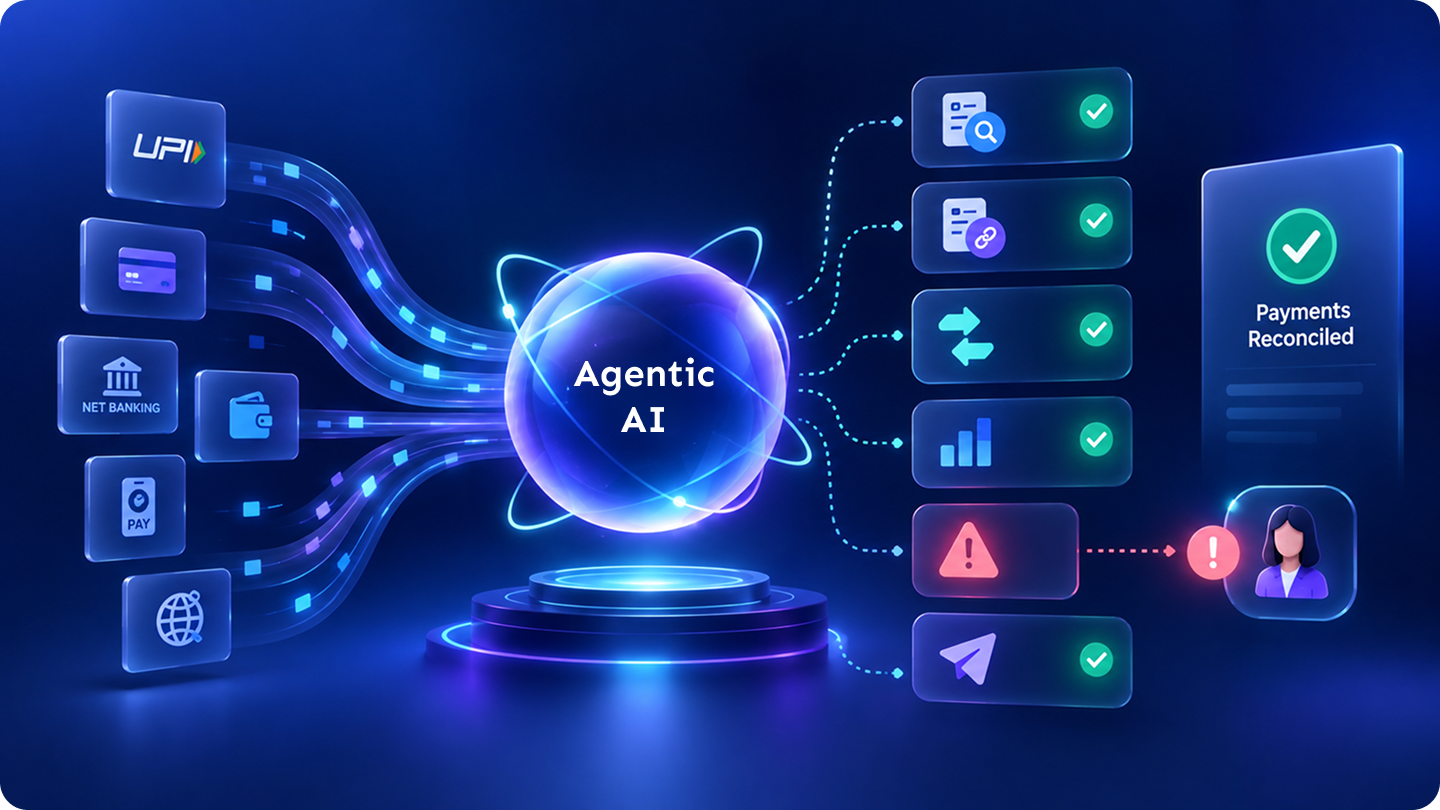
Check the incoming payment data.
Match payments against outstanding invoices.
Identify transactions that do not reconcile.
Investigate the available information.
Flag exceptions that need human attention.
Trigger an appropriate follow-up for the remaining cases.
The important distinction is action.
A generative AI system might tell you which invoice appears unpaid.
An agentic system could potentially identify the invoice, check the relevant payment information and initiate the next approved action.
That does not mean an agent should have unlimited authority.
In payments, the opposite is true: the more autonomy an AI system has, the more precisely its permissions need to be defined.
Traditional Automation vs Generative AI vs Agentic AI
| Route | Typical settlement time | Fee visibility | Agentic AI |
|---|---|---|---|
|
What it does |
Follows predefined rules and workflows |
Generates content, answers, or insights based on inputs |
Plans and executes multiple steps toward a defined goal |
|
Decision-making |
Uses fixed logic and predefined conditions |
Interprets inputs and generates a response or recommendation |
Makes intermediate decisions and takes actions within defined boundaries |
|
Payments example |
Decline a transaction above a fixed limit |
Draft a response to a payment dispute |
Monitor payments, identify mismatches, and trigger an approved resolution workflow |
|
Main limitation |
Struggles with situations outside predefined rules |
Usually requires a person or another system to act on its output |
Can take an incorrect action, making guardrails, permissions, and human oversight important |
The distinction is important because not every AI-powered payment feature is agentic.
A fraud model that scores a transaction, for example, may automatically approve or decline it. That shares some characteristics with agentic systems because a decision is being made automatically, but it is generally much narrower and more constrained than a general-purpose AI agent.
Agentic AI is broader: it can potentially reason across several steps, use tools and take action toward a defined objective.
Why Agentic Payments Matter Now
The shift toward agentic payments is happening because AI is moving beyond simply helping people find information.
AI agents are increasingly being designed to search, compare, decide and act.
That creates a fundamental change in commerce.
Today, a typical digital journey looks something like this:
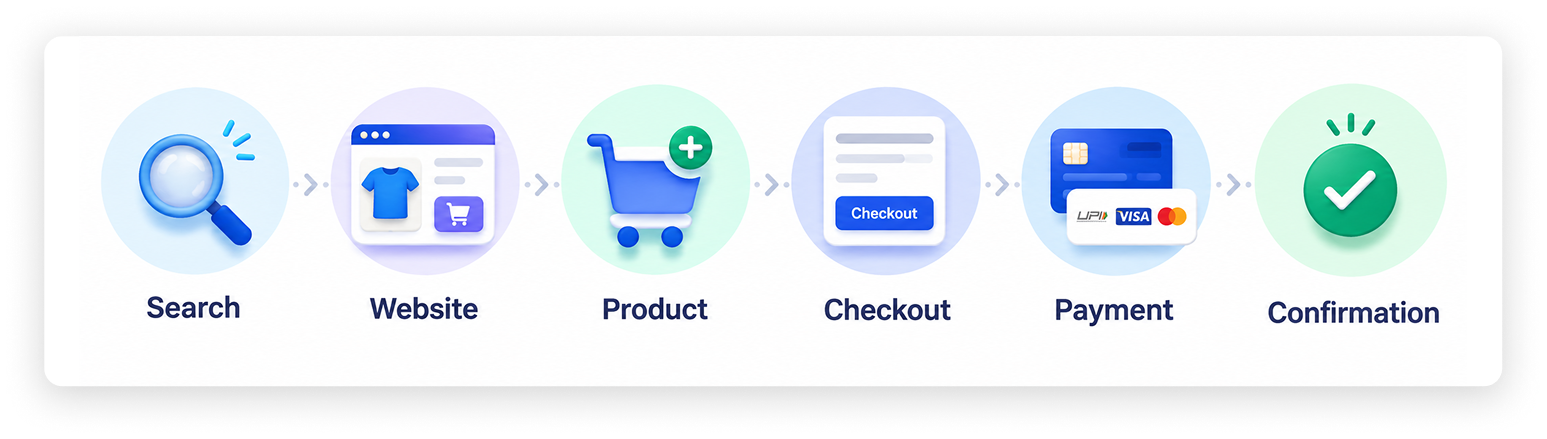
In an agent-driven journey, the customer may simply state an objective:
“Find me the best option within my budget and buy it.”
The AI could potentially handle the search, comparison and decision-making, with payment infrastructure completing the transaction according to the customer's permissions.
Global payment networks and technology companies are already exploring this direction. In India, the development of a proposed Unified Agent Protocol indicates that the same question is now being addressed at the UPI infrastructure level.
But this does not mean every checkout is about to disappear.
The transition will likely happen in stages:

Discovery
An AI agent searches for products, services or prices.

Recommendation
It compares available options against the user's preferences

Initiation
It starts a transaction after receiving appropriate authorisation.

Transaction
It completes a payment within defined limits.

Orchestration
It manages a larger workflow involving discovery, payment, fulfilment, refunds, reconciliation or other post-payment actions.
The industry is still early in this journey.
For businesses, that is actually useful news. You do not need to redesign your entire payment experience overnight.
You need to understand which parts of your payment operation can become more intelligent first.
Where Agentic AI Is Already Doing Real Work
The most useful applications of agentic AI may not be visible to customers at all.
They are happening inside the payment and financial operations that businesses deal with every day.
| Use case | What AI can do | Business impact |
|---|---|---|
|
Fraud and risk |
Analyse transaction signals and trigger an appropriate response |
Helps reduce fraud while limiting unnecessary friction |
|
Reconciliation |
Match incoming payments against invoices and identify exceptions |
Reduces manual reconciliation work |
|
Payment recovery |
Identify failed recurring payments and initiate approved retry workflows |
Helps recover otherwise lost revenue |
|
Treasury and cash visibility |
Analyse payment and receivable information to identify cash-flow patterns |
Gives finance teams better visibility for decision-making |
|
Support |
Understand payment, refund or settlement queries and resolve or route them |
Reduces repetitive support workloads |
The common thread is important.
These applications do not require an AI agent to have unrestricted access to a bank account.
They can operate within a narrowly defined job:
Check this. Match this. Flag this. Retry this. Explain this.
That is one reason operational applications are likely to mature faster than fully autonomous consumer checkout.
The First Opportunity for Businesses May Be Reconciliation, Not Checkout
There is a tendency to think about agentic commerce through the most visible use case:
“Will AI buy things for me?”
For businesses, a more important question may be:
“What financial work can AI stop my team from doing manually?”
Reconciliation is a good example.
A finance team may have to compare payment gateway reports, bank statements, invoices, refunds and settlement information across multiple systems.
An AI-enabled workflow could help identify which transactions match, which do not and which cases need human attention.
That changes the value proposition.
Instead of asking AI to replace the payment gateway, businesses can use AI to make the payment infrastructure around the gateway more intelligent.
This is likely to be one of the most practical starting points for Indian businesses.
How India Is Building Toward Agentic Payments
India is particularly interesting because UPI already provides a payment rail operating at enormous scale.
UPI processed a record 24.51 billion transactions worth ₹29.82 lakh crore in August 2026, according to reported NPCI data. Recent reporting says NPCI is developing a Unified Agent Protocol that could allow AI agents to conduct controlled payments through UPI.
The proposed approach is not about simply giving an AI access to someone's bank account.
The idea is to create a framework around identity, authorisation, spending limits, rules and accountability.
Existing UPI mechanisms such as UPI Circle and Reserve Pay are relevant to this direction because they already provide ways to delegate payment authority or set aside funds for future payments.
The broader principle is important:
AI should not receive unlimited payment authority simply because it can make decisions.
Instead, an agent should operate within permissions defined by the customer and the payment infrastructure.
That could mean rules such as:
-

Maximum amount per transaction
-
Maximum amount per day
-
Approved merchants or categories
-
Frequency of payments
-
Conditions under which a payment can be made
-
When human approval is required
Recent reporting indicates that NPCI's proposed framework is being designed around these kinds of controls, with regulatory considerations still part of the rollout process.
For businesses, this matters because agentic payments will not simply be an AI problem.
They will be a payment infrastructure, trust and compliance problem as well.
What Does This Mean for Indian Businesses?
The impact will differ depending on the type of business.
For ecommerce businesses
AI agents could increasingly become part of how customers discover products and make purchase decisions.
That means businesses may need payment infrastructure that works even when the customer journey does not begin and end on their website.
For SaaS businesses
AI could monitor subscriptions, identify failed payments and trigger approved recovery workflows.Instead of waiting for a customer to discover that a payment failed, the system can act earlier.
For marketplaces
Agentic workflows could assist with payments, refunds, payouts, settlement monitoring and exception management.
For education and service businesses
AI could help manage recurring collections, payment reminders, reconciliation and customer queries without requiring teams to manually monitor every transaction.
For finance teams
The biggest opportunity may be operational.
AI can potentially reduce the amount of time spent moving information between payment reports, bank statements, invoices and internal systems.
The common requirement across all of these businesses is the same:
AI needs reliable payment infrastructure underneath it.
The Compliance Layer Businesses Cannot Ignore
An AI agent that can access financial information or initiate payments cannot be treated like an ordinary chatbot.
It needs to operate within the same regulatory and security environment as the payment systems it interacts with.
-
Data protection
-
What customer data can the agent access?
-
Why does it need that data?
-
How long can it retain it?
-
What happens when permission is withdrawn?
-
Can the business demonstrate what the agent accessed and why?
-
Payment data and localisation
-
Consent and financial data sharing
India's Digital Personal Data Protection framework creates obligations around the processing of personal data.
For an AI agent, that raises practical questions:
These questions need to be addressed at the system-design level rather than after an AI workflow has already been deployed.
Businesses also need to understand where payment and financial data is stored and processed.
This becomes particularly important when AI systems involve third-party models or infrastructure hosted outside India.
Before deploying an AI-powered payment workflow, businesses should understand:
Where is the data stored? Who can access it? Which systems process it? And what controls exist around that access?
India's Account Aggregator ecosystem provides a consent-based framework for sharing financial information between participating institutions.
For AI systems that need a broader financial picture, consent-based data sharing is significantly more appropriate than relying on credentials, screen scraping or uncontrolled access.
The principle is simple:
An AI agent should know only what it needs to know, and only for as long as it is authorised to use it.
Is Agentic AI Safe for Payments?
There is no simple yes-or-no answer.
Agentic AI can make payment operations faster and more efficient, but autonomy introduces a different class of risk.
An AI system can act at machine speed.
If it makes a mistake, that mistake can potentially be repeated across hundreds or thousands of transactions before a person notices.
Prompt injection
An agent may interact with external information such as product pages, emails or messages.
If malicious instructions are embedded in that information, the agent could potentially be manipulated into taking an action that was not intended by the user.
Incorrect decisions
AI can misunderstand information, select the wrong option or make a recommendation based on incomplete data.
Excessive permissions
The biggest risk may not be the AI itself.
It may be giving an AI agent more authority than it needs.
A useful security principle is:
The agent that reads untrusted external information should not automatically be the same agent that has authority to spend money.
Separating these responsibilities creates a narrower and more auditable path between information and payment execution.
For higher-risk transactions, businesses should also maintain a human-in-the-loop process.
The objective is not to eliminate human involvement completely.
It is to make sure humans are involved where human judgement adds the most value.
What Indian Businesses Should Do Now
You do not need a fully autonomous payment strategy today.
But you should start preparing for payment infrastructure in which AI becomes another way of interacting with your systems.
Here are five practical steps
-
Separate access from authority
An AI agent that can read information should not automatically have permission to spend money.
Keep data access and payment authority separate.
-
Define clear limits
For every automated financial action, define:
-
What can the system do?
-
Up to what value?
-
How frequently?
-
Under what conditions?
-
When must a human approve it?
-
-
Build auditability into the workflow
Every AI-driven financial action should leave a clear record of:
what happened, why it happened and which authority allowed it.
-
Start with operational use cases
Do not begin with the most ambitious AI use case.
Start with problems where the business already has measurable inefficiencies:
-
Reconciliation
-
Payment failure recovery
-
Settlement monitoring
-
Customer support
-
Fraud and risk operations
These are easier to measure and generally require less autonomy than fully automated purchasing.
-
-
Ask your payment partner the right questions
As AI becomes part of payment operations, businesses should ask payment providers:
-
How is transaction data protected?
-
Where is it stored?
-
What APIs are available for AI-driven workflows?
-
Can payment status and settlement information be accessed programmatically?
-
What controls exist around automated actions?
-
How are permissions and audit trails managed?
-
The payment gateway of the future will need to answer questions that go beyond:
“How quickly can I integrate checkout?”
It will also need to answer:
“How easily can my systems and AI agents securely interact with my payment infrastructure?”
How Easebuzz Is Approaching AI-Native Payments
This is where the shift from traditional payments to agentic workflows becomes particularly relevant.
The future of payments is not simply about adding an AI chatbot to a payment platform.
It is about making payment infrastructure easier for people, software and AI systems to interact with.
At Easebuzz, that thinking is reflected across three areas.
ERA brings AI into payment-related support, queries and assistance, helping businesses and users get answers without depending entirely on manual support processes.
AI Forms takes the idea further by turning business requirements into payment workflows, reducing the manual effort involved in configuring and managing processes.
And MCP-enabled payments open the possibility for AI tools and assistants to interact more directly with payment infrastructure through structured capabilities rather than relying only on traditional dashboard-driven workflows.
The objective is not to claim that a fully autonomous checkout has already arrived.
It is to build payment infrastructure that is AI-ready.
That means when a business's own AI system needs to check a payment status, understand a transaction, initiate an approved workflow or work with payment data, the infrastructure underneath should be able to support that interaction securely and reliably.
The bigger shift is from:
“AI that talks about payments”
to
“AI that can work with payment infrastructure.”
That distinction is where the next generation of payment experiences will be built.
Conclusion
Agentic AI in payments is not a single product that businesses will suddenly switch on.
It represents a broader shift in how much a digital system is trusted to act rather than simply advise.
India is beginning to build the infrastructure and governance needed to support that shift, with UPI emerging as an important part of the conversation.
But businesses do not need to wait for a world where AI buys everything on their behalf.
The opportunity is already closer to home.
Reconcile payments faster. Recover failed transactions. Improve fraud decisions. Automate repetitive financial workflows. Give teams better visibility into cash and settlements.
The future of agentic payments will ultimately depend on trust.
And that trust will not come from how intelligent an AI model is.
It will come from the payment infrastructure, permissions, security and controls built around it.
FAQ's
What is agentic AI in payments?
Agentic AI in payments refers to AI systems that can understand a financial objective, make decisions across multiple steps and execute approved actions. Examples can include payment reconciliation, payment recovery, transaction monitoring or, eventually, completing purchases within defined limits.
Is agentic AI already live on UPI in India?
India is actively developing infrastructure for agentic payments on UPI. NPCI is working on a proposed Unified Agent Protocol designed to enable controlled AI-led transactions, with spending limits, identity and accountability mechanisms being part of the reported approach. The ecosystem is still evolving.
How is agentic AI different from a payment chatbot?
A chatbot primarily answers questions.
An agentic system can potentially take action based on those answers. For example, instead of only telling a merchant that a payment failed, an agent could identify the failure, determine whether a retry is permitted and trigger the approved next step.
Is agentic AI safe for financial transactions?
It can be, provided it operates within clearly defined permissions and controls. Businesses should consider spending limits, access controls, audit trails, separation between data access and payment authority, and human approval for high-risk transactions.
Will agentic AI replace payment gateways?
Not necessarily.
Instead, payment gateways are likely to become part of a broader infrastructure layer that supports interactions between customers, businesses, software and AI agents.
Where is agentic AI having the biggest impact today?
The most practical applications are currently in areas such as fraud and risk management, reconciliation, payment recovery, customer support and financial operations rather than fully autonomous consumer checkout.
How can businesses prepare for agentic payments?
Start with operational use cases where AI can deliver measurable value today. Improve reconciliation, payment recovery and transaction visibility, establish clear permissions and audit trails, and choose payment infrastructure that can support secure API- and AI-driven workflows.
Share: