
Online GST Calculator – Updated for GST 2.0 Policy
Easebuzz simplifies taxes with its user-friendly GST calculator, eliminating complex calculations for businesses of all sizes — buyers, manufacturers, and wholesalers. Designed in line with the latest GST 2.0 Policy updates, it ensures accurate and compliant tax calculations within seconds. Make informed financial decisions, reduce errors, and avoid unnecessary compliance burdens with a tool that streamlines GST management in just minutes.

What is GST calculator?
GST is a tax that the government applies to the value added at each stage of a product's journey, from production to the final sale. GST calculator is a ready-to-use calculator determine the gross or net price of your products. This calculator is apt for use by users of all types of trade - buyers, sellers etc. It is an essential tool for businesses to ensure that they are compliant with GST regulations and avoid penalties.
New Tax Slabs for Goods & Service Tax (GST)
GST, when implemented in India, brought uniformity in tax collection across the country. In the GST regime, tax is levied at every stage of the supply chain, with input tax credit ensuring there is no cascading effect. There are five major GST slabs - 0%, 5%, 12%, 18%, and 28% and different goods and services fall under different tax categories. With ongoing GST reforms (GST 2.0), the government aims to further simplify and rationalize the tax structure.
Calculate GST Now
Business benefits of using online GST calculator
-
1. Accuracy guaranteed: Eliminate calculation errors and ensure compliance with GST regulations.
-
2. Time saver extraordinaire: Automate calculations and free up time for other tasks.
-
3. Price crafting made easy: Accurately determine product pricing and make informed decisions.
-
4. Cash flow mastery: Forecast GST liability and manage cash flow effectively.
-
5. Stress-free compliance: Stay up-to-date with GST rules and avoid penalties.
The free GST calculator helps businesses determine the price for gross or net product depending on the amount and gives entrepreneurs a split of percentage-based GST rates. It helps with the division of rate between CGST and SGST or calculating IGST accurately.
Types of GST applicable in India
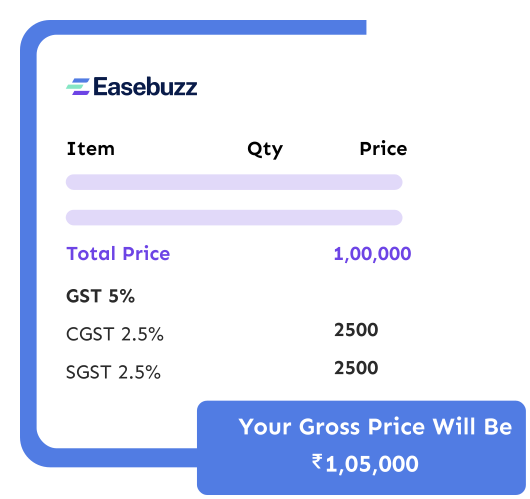
CGST
CGST is the indirect tax levied by the Central Government. It is imposed on transaction of goods and services which are undertaken within the state i.e. intrastate. The tax collected under the heading “CGST'' is payable to the central government treasury.
SGST
SGST is tax imposed by the State Government. SGST. It is levied on intrastate sales of goods and services, i.e., sales made within a state. It includes the amalgamation of State Sales Tax, Luxury Tax, Entertainment Tax, Levies on Lottery, Entry Tax, and other taxation's related to the movement of commodities and services under state authority through one uniform taxation.
IGST
IGST is applied on the interstate supplies of goods and services. For example, if the supply of goods and services occurs between Gujarat and Rajasthan, IGST will be applicable. IGST is also applicable on the goods imported to distribute among the respective states.
UTGST
UTGST and SGST share a commonality: both entail taxation revenue. The sole distinction lies in the destination of the tax funds, as UTGST directs them towards the treasury of the relevant Union Territory where the goods or services have ultimately been utilized. The UTGST is applicable to Union territories like Delhi, Lakshadweep, Damn and Diu, Dadra and Nagar Haveli, Andaman and Nicobar Islands, Chandigarh.
How to calculate GST with online GST calculator
Formula for GST calculation
GST Amount = (Original Cost*GST Rate Percentage) / 100. Net Price = Original Cost + GST Amount.
Examples for understanding GST calculation:
Assume in the year 2023, an entrepreneur from the electronic industry produces fancy gadgets (10% tax rate applicable) each worth ₹500 and sends to a warehouse for labelling & packaging. The warehouse adds ₹50 to the existing value of the goods. Then, sell it to the retailer. The retailer adds its advertisement cost of ₹50. Let’s break it down.
-

Step 1: The Entrepreneur's Product
Imagine you're an entrepreneur who creates a product, let's say it's a fancy gadget. The cost to produce this gadget is ₹500.
-
Step 2: Sending to the Warehouse
Now, you want to make your gadget look even better, so you send it to a warehouse. The warehouse adds labels, packaging, and other improvements to your gadget. These improvements cost ₹50.
-
Step 3: Selling to the Retailer
With the improved gadget in hand, the warehouse sells it to a retailer. The retailer, in this case, wants to promote your gadget and decides to add an advertisement cost of ₹50.
Now, let's understand how GST comes into play:
How GST works - New Rules Explained
To calculate GST under the current GST framework, we first identify the nature of the transaction. In this example, goods move from a manufacturer → warehouse → retailer, which is a taxable supply. GST is applied at the applicable slab rate (for example, 18%).
| Particulars | Cost (₹) | GST @18% (₹) | ITC Claimed (₹) | Tax Deposited to Govt (₹) | Invoice Total (₹) |
|---|---|---|---|---|---|
Manufacturer |
500 | 50 | - | 90 | 590 |
Warehouse (adds ₹50 value) |
550 |
99 |
90 | 9 |
649 |
Retailer (adds ₹50 value) |
600 |
108 |
99 | 9 |
708 |
-
GST is charged at every stage of value addition.
-
Each business claims Input Tax Credit (ITC) on GST already paid.
-
Only the value addition is taxed, preventing cascading.
-
The final burden is borne by the end consumer.
Examples of GST Rates - 2.0
-
Under GST 2.0 reforms, the government continues to simplify and rationalize the GST structure while keeping the main tax slabs of 0%, 5%, 12%, 18%, and 28%. GST is applied based on the type of goods or services, and businesses must charge the correct rate as per category. The system ensures tax is collected at every stage of supply, with Input Tax Credit helping avoid double taxation.
-
For example, essential food items may attract 0% GST, household essentials fall under 5%, items like mobile phones and processed foods may attract 12%, most services fall under 18%, and luxury goods such as premium cars attract 28%. These slabs help businesses calculate taxes correctly and stay compliant.

What is GST (Goods & Service Tax)?
GST, or Goods and Services Tax, is a single tax applied to most things you buy in India. Think of it like a simplified VAT, replacing multiple old taxes with one easy-to-understand system. This means less confusion, fairer prices, and a smoother business environment for everyone!
GST Inclusive vs GST Exclusive – Key Difference
GST Inclusive means the price already includes GST. For example, if the price is ₹1,180 (inclusive of 18% GST), the base price is ₹1,000 and ₹180 is GST you pay ₹1,180 only. GST Exclusive means GST is added to the base price. For example, if the base price is ₹1,000 and GST is 18%, ₹180 is added, so you pay ₹1,180 in total. Inclusive pricing is common for customers, while exclusive pricing is mostly used in business billing.
What is GSTIN (Goods & Service Tax Identification number)?
GSTIN (Goods and Services Tax Identification Number) is a unique 15-digit number given to every business registered under GST in India. It is required for collecting GST, filing returns, and claiming Input Tax Credit (ITC). Businesses that cross the prescribed turnover limit or fall under mandatory registration must obtain a GSTIN to operate legally. For example, in GSTIN 27ABCDE1234F1Z5, “27” represents the state code, the next 10 digits are the business PAN, and the last digits are system-generated for identification. GSTIN ensures transparency, smooth compliance, and proper tax tracking for businesses.
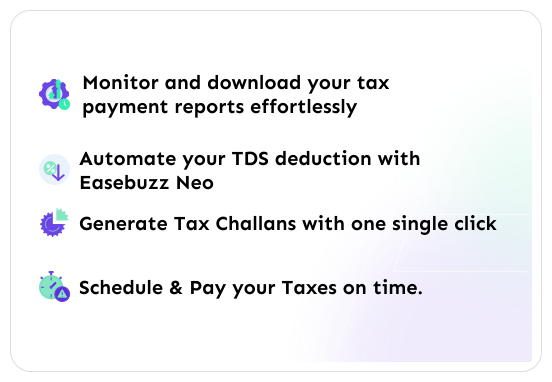
Automate tax payment with Easebuzz Payments Platform
Businesses can manage receivables and payables effortlessly with Easebuzz.
Frequently Asked Questions
GST calculation can be explained by simple illustration : If a goods or services is sold at Rs. 1,000 and the GST rate applicable is 18%, then the price calculated will be = 1,000+ (1,000X(18/100)) = 1,000+180 = Rs. 1,180.
GST Amount = (Original Cost*GST Rate Percentage) / 100. Net Price = Original Cost + GST Amount.
A simple example of how GST is calculated typically by business owners.
| Particulars | Rate(%) | Amount |
|---|---|---|
| Invoice value | 12% |
3,00,000 |
GST |
12,000 |
|
Price to be charged on the Invoice |
3,24,000 |
Manufacturers can enter the cost of production/cost of goods, profit ratio percentage, and rate of GST.
| Particulars | Rate(%) | Amount Pre-GST | Amount under GST |
|---|---|---|---|
| Cost of the product | - |
2,00,000 |
2,00,000 |
| Profit | 10.00% |
20,000 |
20,000 |
| Excise Duty | 12.50% |
27,500 |
Nil |
| Total | - |
2,47,500 |
2,20,000 |
| VAT | 12.50% |
30,938 |
Nil |
| CGST | 6% |
Nil |
13,200 |
| SGST | 6% |
Nil |
13,200 |
| Final Invoice to the wholesaler | - |
2,78,438 |
2,46,400 |
Our GST Calculator provides instant, accurate GST calculations for both inclusive and exclusive amounts. It helps businesses, accountants, and individuals avoid manual errors and save time. The tool is simple to use and works for all GST rates applicable in India.
The GST inclusive amount is the total price of a product or service after adding GST to the base price. It represents the final amount a customer pays. This amount already includes the applicable GST rate.
GST Amount = (Original Price × GST Rate) ÷ 100.
GST Inclusive Price = Original Price + GST Amount.
For inclusive price, GST = Inclusive Price × [GST Rate ÷ (100 + GST Rate)].
Under GST, intra-state sales attract CGST and SGST equally, while inter-state sales attract IGST. CGST goes to the central government, SGST to the state government, and IGST is shared accordingly. GST 2.0 continues this structure with improved compliance and reporting mechanisms.
Both pricing methods are used in India. Retail consumers usually see GST-inclusive pricing, while B2B transactions often use GST-exclusive pricing for clearer tax input credit calculation.
Businesses with annual turnover exceeding the prescribed threshold (generally ₹40 lakhs for goods and ₹20 lakhs for services, subject to state rules) must register for GST. E-commerce sellers and inter-state suppliers are also required to register, regardless of turnover in certain cases.
To find the GST inclusive amount, add the GST amount to the original price. Inclusive Amount = Original Price + (Original Price × GST Rate ÷ 100). This gives the final payable amount.
Anyone including business owners, accountants, freelancers, and consumers can use a GST calculator. It is helpful for billing, invoicing, price comparison, and tax estimation.
To calculate 18% GST, multiply the base amount by 18 and divide by 100. For example, GST on ₹1,000 is ₹180, making the total ₹1,180. This method works for any taxable amount.