CATEGORY - SME
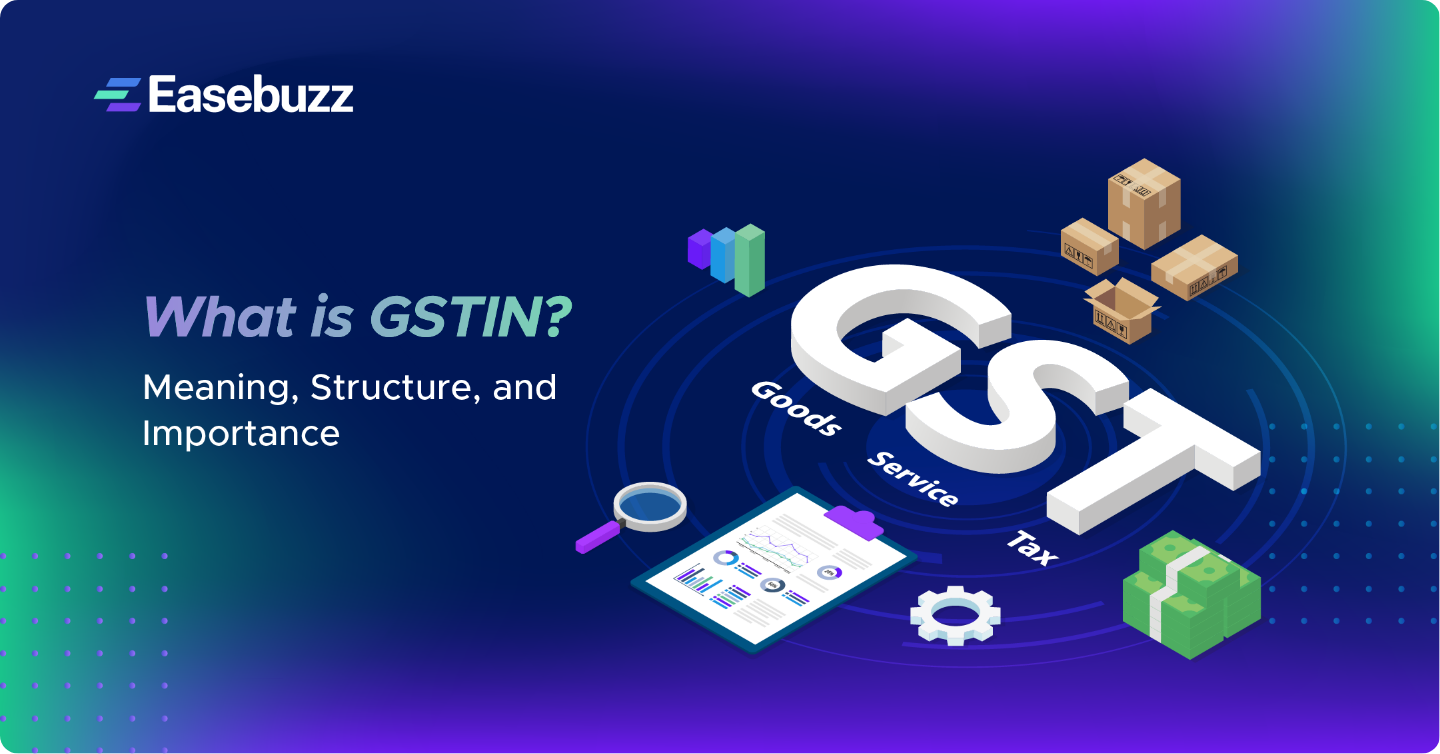
What is GSTIN? Meaning, Structure, and Importance
SME - 24 Apr, 2026
-
Table of Contents
A GSTIN (Goods and Services Tax Identification Number) is a 15-digit unique code assigned to every business registered under India’s GST regime. It enables accurate tax tracking, supports transparent transactions, and ensures businesses stay compliant with GST rules.
What is GSTIN?
GSTIN (Goods and Services Tax Identification Number) is a unique 15-digit ID assigned to every business registered under India’s GST system. Introduced with the GST regime in July 2017, it replaced older identifiers like VAT, Service Tax, and CST numbers, bringing all indirect taxes under one unified structure. Any business crossing the prescribed turnover limit or involved in inter-state transactions must register under GST and obtain a GSTIN for compliant invoicing, tax filing, and operations.
Why is GSTIN Important for Businesses?
-

Ensures Full Legal Compliance: A GSTIN is mandatory for filing returns, issuing GST invoices, claiming ITC, and carrying out tax-compliant business transactions.
-
Builds Trust & Transparency: It enables the government—and your business partners—to verify tax authenticity, reducing risks of fraudulent or unregistered vendors in your supply chain.
-
Unlocks Input Tax Credit (ITC) Benefits: Businesses can claim ITC only when their suppliers have a valid GSTIN, directly impacting profitability and working capital efficiency.
-
Simplifies Tax Management: With one unified GST identification number, businesses avoid multiple tax systems, making documentation, reporting, and audits far easier.
-
Supports Smooth Inter-State Operations: GSTIN is essential for compliant trade across states, e-commerce sales, logistics movement, and interstate billing.
-
Strengthens Vendor Verification: GSTIN validation helps businesses onboard legitimate suppliers and avoid penalties from incorrect or fake GST numbers.
How is a GSTIN Constructed? (15-Digit Format Explained)
A GSTIN (Goods & Services Tax Identification Number) is a 15-digit alphanumeric code, where every digit has a specific purpose:
-
1–2: State Code:
Represents the Indian state/UT as per the 2011 Census.
Examples: 27 = Maharashtra, 07 = Delhi, 29 = Karnataka. -
3–12: PAN of the Business:
These ten characters match the business entity’s Permanent Account Number, linking GST identity to tax records. -
13th Digit: Entity/Registration Number:
Shows the number of GST registrations a business has under the same PAN in a particular state. (Useful for businesses with multiple branches/verticals.) -
14th Digit: Default Alphabet ‘Z’:
Reserved for future use; currently fixed as Z across all GSTINs. -
15th Digit: Checksum Character:
A system-generated alphanumeric digit used to verify the authenticity and detect errors in the GSTIN.
A Sample of GSTIN
Example: 27GHFVG8567N1Z5
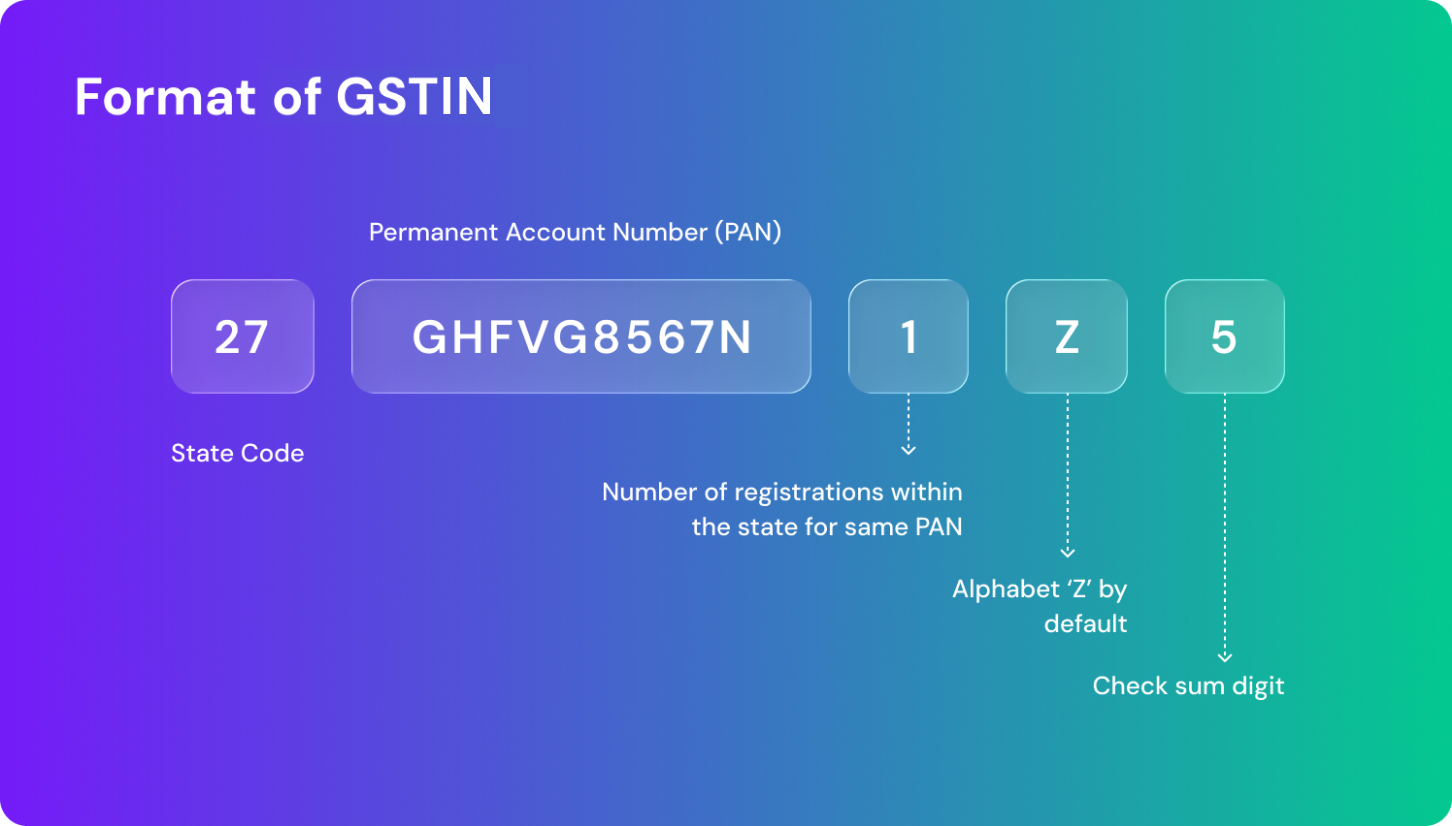
Breakdown of the GSTIN Structure
-
27 - State Code:
Represents the state where the business is registered. (E.g., 27 = Maharashtra) -
GHFVG8567N – PAN of the Business
The 10-digit Permanent Account Number of the entity. -
1 – Entity Number
Indicates the number of registrations the same PAN holds within that state (1 = first registration). -
Y – Default Alphabet
Reserved for future use; always ‘Y’ as per GST format. -
5 – Checksum Digit
Used to validate the authenticity of the GSTIN and prevent errors.
Who Should Obtain a GSTIN in India?
Businesses must obtain a GSTIN if they fall under any of the following categories:
-
Turnover Threshold: Businesses with an annual turnover exceeding the prescribed limit (₹40 lakh for most states, ₹10 lakh for special category states).
-
Inter-State Supply: Entities supplying goods or services across state borders.
-
E-commerce Operators & Aggregators: Platforms facilitating sales by multiple vendors online.
-
Reverse Charge Mechanism: Businesses required to pay GST under reverse charge.
-
Non-Resident Taxable Persons: Overseas entities supplying goods/services in India.
-
Input Service Distributors (ISD) & Casual Taxable Persons: Businesses distributing input tax credit or operating temporarily in India.
Steps to Obtain a GSTIN in India
-
Visit the Official GST Portal
Go to www.gst.gov.in and navigate to the GST registration section. -
Fill Out GST Registration Form (Form GST REG-01)
Provide basic details including your PAN, mobile number, and email ID to start the registration process. -
Submit Business & Supporting Documents
Enter your business details, upload proof of address, identity documents, and bank account information as required. -
Complete Verification
Verify your details via OTP/email, and ensure all documents are correctly uploaded. -
Receive GSTIN
Once the application is approved by GST authorities, a 15-digit GSTIN is issued along with a digital registration certificate.
Common Mistakes to Avoid While Using GSTIN
-
Quoting Incorrect GSTIN on Invoices: Using a wrong or invalid GSTIN can lead to mismatches in GST returns, denial of Input Tax Credit (ITC), and compliance penalties.
-
Not Updating GSTIN Details: Any changes in business structure, PAN, registered address, or ownership must be updated in the GST portal promptly to avoid legal and tax issues.
-
Delayed Filing of GST Returns: Late or incorrect filing with an outdated GSTIN can block ITC claims, attract interest, and trigger compliance notices.
-
Using GSTIN of Another Entity: Avoid quoting someone else’s GSTIN. It is illegal and can lead to penalties, including fines and potential audits.
-
Ignoring GSTIN Verification for Vendors: Failing to verify vendor GSTINs before transactions can result in dealing with fake or unregistered suppliers, risking financial loss and invalid ITC claims.
-
Incorrect GSTIN Format: A GSTIN must follow the 15-digit format. Missing or extra digits, or wrong state code, can cause system errors during filing and reconciliation.
-
Overlooking GSTIN on Digital Invoices: Ensure GSTIN is always correctly mentioned on e-invoices and digital receipts to maintain compliance and smooth business operations.
Key Use Cases of GSTIN for Businesses
-
Filing GST Returns: A valid GSTIN is mandatory for filing all GST returns online. It ensures accurate tracking of tax liability and compliance with GST regulations.
-
Invoicing Compliance: Every tax invoice must include the GSTIN of the supplier and, where applicable, the recipient. This guarantees invoice validity and enables seamless Input Tax Credit (ITC) claims.
-
Claiming Input Tax Credit (ITC): GSTIN verification ensures that both buyer and supplier GSTINs match in the GSTN portal. Only invoices linked to verified GSTINs are eligible for ITC, preventing errors or fraud.
-
Inter-State Transactions: GSTIN ensures proper tax identification and compliance across state borders, crucial for businesses engaged in interstate sales and logistics.
-
Vendor Verification: GSTIN helps verify the authenticity of suppliers, reducing the risk of dealing with fraudulent entities or fake GST registrations.
-
Audit & Regulatory Compliance: A valid GSTIN ensures smooth audits and compliance reporting, helping businesses avoid penalties and legal complications.
-
E-Invoicing & Digital Integration: GSTIN is required for generating e-invoices and integrating with digital accounting, ERP, or payment systems, streamlining finance and accounting processes.
-
Cross-Border Trade & Export Documentation: For exporters and importers, GSTIN is used for tax exemptions, refunds, and official trade documentation, enabling seamless cross-border compliance.
Difference Between GSTIN and GSTN
| Feature | GSTIN (Goods and Services Tax Identification Number) | GSTN (Goods and Services Tax Network) |
|---|---|---|
Definition |
A 15-digit unique identification number assigned to each GST-registered taxpayer in India. |
The IT infrastructure and platform that manages all GST-related processes, compliance, and data across India. |
Purpose |
Identifies taxpayers for GST collection, input tax credit claims, invoicing, and compliance. |
Provides the technological backbone for registration, returns filing, payments, reconciliation, and data analytics. |
Nature |
Unique alphanumeric code for every business or entity registered under GST. |
IT system/portal used by taxpayers, tax authorities, and government agencies. |
Issued By |
GST authorities under the Ministry of Finance after successful GST registration. |
Developed and maintained by the Goods and Services Tax Network in collaboration with the Government of India. |
Format / Structure |
15 digits: 2-digit state code + 10-digit PAN + 1-digit entity code + ‘Z’ + 1 check digit. |
No format; it’s a digital platform accessible online for all GST processes. |
Primary Use |
Used on invoices, returns, and official communications to uniquely identify taxpayers. |
Used for GST registration, return filing, payment processing, reconciliation, and data management. |
Business Impact |
Ensures smooth compliance, input tax credit claims, and auditing transparency. |
Enables efficient, secure, and real-time GST operations for businesses and tax authorities. |
Conclusion
-
GSTIN is the unique identity number for a taxpayer.
-
GSTN is the digital system/portal that enables businesses and authorities to manage GST efficiently.
-
Understanding both is crucial for compliance, ITC claims, accurate invoicing, and streamlined tax operations.
FAQs
GSTIN Search?
You can search a GSTIN online using government portals or tools like the Easebuzz GST Number Search. Enter the 15-digit GSTIN to instantly verify business details, registration status, and compliance.
GSTIN Full Form?
GSTIN stands for Goods and Services Tax Identification Number, a unique 15-digit code assigned to each GST-registered business in India.
How to Check GSTIN Number?
Visit a GST verification tool or the official GST portal. Enter the 15-digit GSTIN to get the legal name, registration status, and state code instantly.
What is GSTIN Number?
A GSTIN is a unique 15-digit identifier for businesses registered under GST. It’s required for filing returns, claiming input tax credits, and maintaining compliance with Indian tax laws.
How to Get GSTIN Number?
GSTIN is issued after registering your business on the GST portal. Submit your PAN, business documents, bank details, and address proof. Once approved, the portal provides your GSTIN digitally.
What is GSTIN Number in PAN Card?
The GSTIN is linked to your PAN; the 10-digit PAN forms part of the 15-digit GSTIN. It ensures each GSTIN is unique to the business and correctly tied to its tax identity.
What is GSTIN, and why is it important?
GSTIN is essential for legal compliance, filing returns, issuing valid invoices, and claiming input tax credits. It protects businesses from penalties and ensures smooth tax operations.
Is GST Registration Free?
Yes, GST registration and obtaining a GSTIN are completely free when done via the official GST portal. No fees are required unless you use a third-party service provider.
Can a Business Have Multiple GSTINs?
Yes, if a business operates in multiple states or has multiple business verticals, it must register separately in each state, resulting in multiple GSTINs under the same PAN.
What Happens if the GSTIN on an Invoice is Incorrect?
Incorrect GSTINs can lead to failed reconciliation, denial of input tax credit (ITC), and penalties during audits. Always verify vendor GSTINs before invoicing.
Is it Mandatory to Display GSTIN at the Place of Business?
Yes, registered businesses must prominently display their GSTIN at the principal place of business and mention it on all invoices, bills, and official communication.
What is the Penalty for Not Obtaining GSTIN?
Businesses required to register under GST but failing to do so can face penalties of 10% of the tax due or ₹10,000, whichever is higher, along with interest on unpaid taxes.
Share: